Showing posts with label book review in a lift. Show all posts

Sunday, February 04, 2024

How to Fail, a great read by a very successful writer


A New Year resolution was to read more. That's it. Nothing fancy, just read more.

I'll update on here with reviews, possibly clustering on a few authors that I've binged on.

I breezed through the very readable How to Fail by Elizabeth Day, whose novels Paradise City and Magpie I really enjoyed. I have listened to the podcast too, but not enough to recall it in great detail.

This is a memoir of sorts, but ever so slightly self-helpy too. It gave me flashes of Miranda Sawyer's Out of Time - Midlife If You Still Think You Are Young, and triggered similar bouts of personal self-reflection, which I won't rehash, but I splurged on that here.

By my own measures, Elizabeth Day hasn’t failed at all: I would have loved to have been a feature writer for a national newspaper like the Observer, but it's all relative. She also got to Cambridge, and is an acclaimed novelist and successful podcaster. On the surface, it's hard to see the failure, but I suppose that's the point.

But this a warm and deeply honest book that is hugely generous for the personal vulnerability she shares.

Sunday, October 09, 2022

The Devil Wears Ciro Citterio


The foundation of my love of music was the media that provided the running commentary on the styles, scenes and sounds I grew up with.

Without the New Musical Express, The Face and i-D music would still be good, but it would exist in isolation, without context and without colour.

It was also the rock on which my love of magazines, writing and journalism was built. 

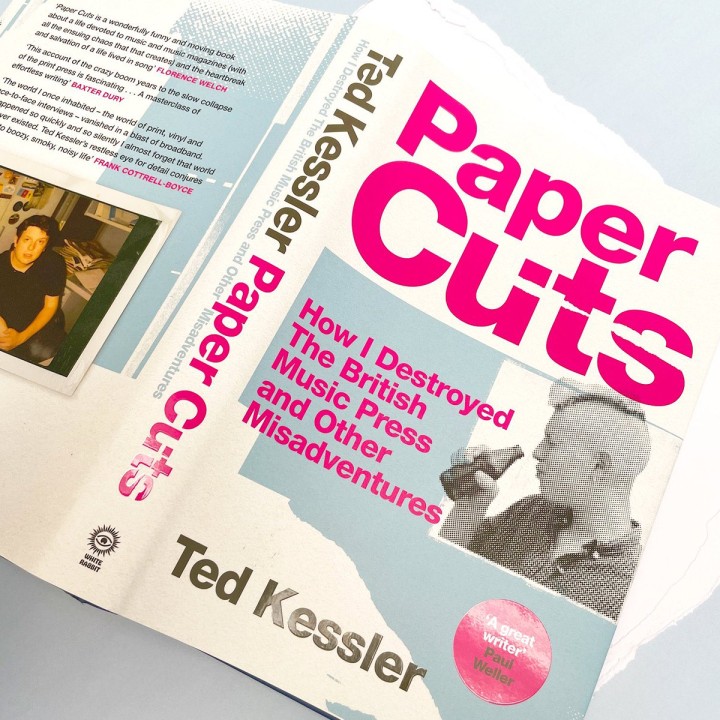
Last weekend I ripped through Ted Kessler’s brilliantly titled book Paper Cuts - How I Destroyed the British Music Press and Other Adventures. This is a longer version of the punchy review I did for the local papers.

The last ever editor of Q Magazine when the music monthly closed at the start of lockdown in 2020, Kessler shares the potent mix of his remarkable life story, interwoven with a rich commentary about the decline of the music press.

The other eye I had on this tale was my own early career choices. I often think about this world as a parallel universe down another fork on my life’s road. I started out writing about music, fashion, films and clubs but took that different path in my early twenties. Many other young journalists probably also compromised on their ambitions, but I do count myself lucky to have landed in an exciting sector. I made my home through the 1990s reporting on the television business and its technology, rather than music, stars and showbiz, later moving to Manchester to edit Insider, the best business magazine in the land. One of the reflections I used to share with journalism students at UCLAN was the access I had to real decision makers and headline makers was so much greater in the business press than I suspect it was in consumer media.

Although I’d interviewed some high-profile celebs in that phase (Ben Elton and the rapper Tone-Loc were favourites, various long-forgotten Australian pop stars, not so much), some of the PR-guided set pieces were excruciating and over-controlled. You really felt you were in their pocket and constantly on parole for good behaviour. Ironically, my best-ever scoop was about the revival of Countdown Revolution, a much-loved TV music show.

As I mentioned in this piece a couple of months ago, I have at times lamented that early choice. But deep down I probably always knew the money wasn’t good enough and the precarious nature of jobbing journalism for cool papers and mags was more than I could bear. Certainly, both Ted Kessler and Miranda Sawyer have confirmed their own financial precarity was a trade-off for an interesting life. 

Journalism is a hustle. You have to constantly negotiate access to a much sought-after interview, or work out the trade-offs required to stay in the game. The business press was a different kind of dance, but there were games to play and the advertisers had more power; too much if you weren’t vigilant. 

To be any good at journalism, in any field, you need courage, access and a genuine love for what you are writing about, if you don't then you are dead, because the gatekeepers have an antenna for it. Writing talent, as Ted Kessler describes, particularly for a high-output media like a weekly paper, isn’t as important. You just have to be able to knock out the copy sometimes.

I enjoyed Ted’s accounts of his own on-the-job learning, well remembering the brutal dressing-downs I had through my early career. I didn’t use words wisely, I was way too slow, and it took a while to balance the relationships that could taint a fair and accurate view of our world.

His tales of press trips and moments of genuine wonder are beautifully told, John Harris and him at an early Oasis gig, the energy of the Happy Mondays, but there was always a tension. These people weren't your friends and could snap in an instant. Maybe it’s also because the stakes were so high and the negative consequences so catastrophic. When he spends time with Radiohead and the editor ditches it as a cover story, relegating it to a chippy inside spread with poorly chosen photos, it triggers a grudge that lasts for a decade.

He gives Paul Weller’s Stanley Road album 6/10 in the NME and Weller invites him down to Surrey for a straightener in the car park of his studio.

I don’t ever remember being offered out by a grumpy TV facilities boss, but I upset plenty of people over the years. Sometimes it was my own fault. I can think of the press officers at major corporations, who were also our advertisers, who thought I was an idiot. I then decided I would go out of my way to deliberately annoy them by doing stories so offensive, so detrimental to their reputation, and so egregiously hostile, that they threatened to withdraw all advertising from my publication, and its sister titles, which were hanging by a knife edge anyway. It was high stakes but boosted my credibility and their requirement to take me seriously. And I was right, by the way, the story I worked hard to get published about them was true. And rather a troublesome idiot than a lickspittle, of which there were plenty elsewhere.

But as I matured I knew better and learned how to earn the right, to play the long game. If you’ve got a good reputation, if you do the work, serve the readers good stories, and try to be different, then your respect yields better stories. In later years, while working on a different magazine, that same advertiser flew me to Rome to interview the head of the Vatican’s TV station, and also to the World Cup in France 98. Though to prove where I stood in the pecking order it was only Bulgaria v Nigeria.

For an industry that holds its annual trade exhibitions in Las Vegas and Amsterdam, I enjoyed those years and had a good innings hanging around things I never fully understood, finding the personalities, spotting trends, and separating good new products from dross.

I was asked recently what my favourite ever story pitch was. It’s easy: “Hi Roger from Quantel here, how would you like to come to the Cannes Film Festival on our private jet?” That was a big deal. Competitors upped their game after that. Spending time with smart people brings insights, insights bring readers, readers bring credibility, and credibility gives you the freedom to be brave. Plus, though I knew Cannes was incredible from trips to the MIPCOM and MIPTV markets, the film festival was next-level insanity and glamour.  

But I think the real reason I really enjoyed Ted Kessler's Paper Cuts was that it was also about the decline of publishing, the collapse of the magazine industry as we knew it, and the self-inflicted wounds that legions of halfwitted publishers administered in the name of brand strategy, diversification and efficiencies. I went through many of the same kind of corporate bollocks that Ted Kessler outlines; strategy days, meetings about meetings, overreacting to anecdotal evidence in reader surveys and off-the-cuff comments from people making an excuse not to advertise. I've lost count of the pointless memos, botched redesigns, paranoia, new managers with the latest bright idea and the sharpening of knives by young bucks on the rise. There was also a clash of priorities between advertising, editorial and corporate merger strategy.

Ted Kessler’s characters, some tragic, leap off the page. Maybe he was blessed with big names and personalities, but for his Steven Wells (RIP), we had Oscar Moore (also, RIP). Yet it remains true that no one has yet written a savage portrait of working in the business press in the way Kessler does about his world, or Laura Weisberger's novel about Vogue, The Devil Wears Prada. I just don't think my magnum opus (The Devil Wears Ciro Citterio) would be quite the rip-roaring page-turner. 

The irony is not lost on me, by the way, that other hardy veterans may have well interpreted my own enthusiasm for events, video and podcasts as equally vomit-inducing careerism and therefore evidence of my own blatant hypocrisy. In a later career incarnation, I sat on the board, advocated change, and embraced the internet. As one of my American journalist friends said, "oh my God, you've become 'they'."

But you only have to look at the absolute bin fire that is the local newspaper industry to know what happens when you get the big calls wrong, promote the wrong people and fall asleep at the wheel. 

But for all of that I have never stopped being a journalist, and a supporter of journalism, and loving the company of journalists, not just because of stories from back in the day, but because of all the stories they tell so well. 

Paper Cuts is stuffed full of hilarious stories of wild encounters that us journalists love retelling. Trips to Cuba with Manic Street Preachers to meet Fidel Castro and dinner with Florence (but not her Machine) at the height of her success, a fair few involving Manchester music legends, Shaun Ryder, the Gallaghers and then there’s Mark E Smith of The Fall asking about the name Kessler: ‘Jew, Or Nazi?’ A story Ted Kessler’s dad bizarrely recounted with morbid glee.

But for all its depictions of a downfall of an industry, and the sad story of his Mum’s passing, the book also ends on an optimistic note. Kessler’s own Substack newsletter The New Cue fizzes with the same energy for new music and a rich heritage. It may not reach the heights of NME in the 80s, but it’s a platform for writing that matters. I hope they get the access they deserve in a world where social media gives artists the ability to totally control their brand and message, but often leaves too little a crack for the light to get in.

Monday, June 06, 2022

The search for modern England


I’ve been thinking a lot recently about England, not the recent disasters of the cricket team, or the resurgence of the football team under Gareth Southgate, but the country of England. The largest, most dominant, and most significant part of the United Kingdom, and what it stands for. Even though we’ve emerged from the four-day celebration of the Queen’s Platinum Jubilee (I bet you all lost track of what day it was), our country feels a little more divided and a not very United Kingdom.

Scottish identity is once again surging and self-confident. Welshness is rooted in language and culture, and like the Scots, fuelled by grievance.

The Irish question seemed to have been solved by the single market for trade with Europe and a careful tolerance of individual identity embedded in the Good Friday Agreement. That looks under grave threat. A united Ireland may soon have to accommodate a belligerent unionist minority in its northeastern corner.

But should all of that happen, what of the England they would leave behind? Unlike the devolved nations it has no parliament of its own, all of the institutions of England are just the same as the British state, but with bits lopped off.

What is English music? What is English food? An English temperament, or character? But before you answer those questions, what is different from how you would describe British things?

At the height of the Euros last year one of my Mum’s neighbours displayed a massive England flag outside his house and defiantly asked her - “does it offend you?” I found that fascinating. Public displays of Englishness as a rebellion against nice people. Or a yearning for better yesterdays.

The so-called comedian Stewart Lee has a whole routine built around the outrage of a taxi driver who claims he couldn’t claim English nationality on his passport application form: “These days you get arrested and thrown in jail just for saying you’re English” (look it up).

But they are grotesque caricatures and oddities, which bring us no closer to what is different about being English, as opposed to British. 

Journalist Jason Cowley has written a very thoughtful book Who Are We Now? Stories of Moden England that tries to capture who the English are through a series of encounters with people who made the news in the last two decades. Often times these are unlikely heroes or ordinary people thrown into the public spotlight in dramatic, often tragic circumstances. They include a Chinese-born man who survived the drownings in Morecambe Bay, the Rochdale pensioner who schooled Gordon Brown on the facts of life in a northern town and was dismissed as ‘some bigoted woman’, and the London bodybuilder who scraped a racist man off the pavement and saved him from a kicking at the hands of a Black Lives Matter protest.


Cowley pulls together a compelling set of stories about what their experience speaks of England today.

But I kept thinking that slipping in an encounter in Wrexham or Stranraer might seamlessly add to the tapestry and say something about what it is to be British instead, but I think we’re way past that point, and no clearer about what England represents. 

The closest Cowley comes to a clear definition is what he calls Southgateism - embodied by the proud and patriotic England football manager - who also pulls a diverse team together to take the knee against racism. But I think there are dangers in reducing a national identity to the roars of support for sport.


I think too of the hedonistic supporters before the Euro 2020 final at Wembley fuelled by booze, drugs and belligerence, one of whom mounted a distress flare from his naked backside. You don’t see other nationalities doing this and I’m sure he’s got a story to tell about what being English means to him. And I think if he asked my Mum if that offended her, she’d say yes, it does.

Friday, September 03, 2021

When Friends Write Books


I have a couple of book projects I'm writing up at the moment. One is at proposal stage, the other is an idea. Having been through the agony and the ecstasy of the writing, pitching and publishing process before, I know what's in store. More than anything though I'm grateful for the support of friends and family. 

It got me thinking about friends who have also written books recently and have therefore been on a similar trek to the peaks and valleys of getting a book out. I'm not trying to make out I'm part of some northern renaissance movement, akin to The Frankfurt School or The Bloomsbury Set, but I am very, very proud of each and every one of them for their efforts and the end result.

I've reviewed a few of them already - so you can click through to see what I liked about the books by my University friend Shobna Gulati, our neighbour David Nolan and Manchester icon Vikas Shah.

Three of the other authors I met on Freshwalks, which says something about the network that has been created. Mark Sutcliffe joined us on a West Pennine walk just before lockdown and we became good mates quickly. Slightly by design, we would speak weekly in a scheduled group chat and I was always interested in what he had to say about anything. He's written a beautiful, handy and warm guide to walks in Lancashire, and as he inscribed in the front, 'three down, 37 to go', reminding me we've made a great start together. The epithet 'warm' is the most important here because I read a lot of walking guides that are very utilitarian. Alfred Wainwright owes his popularity to his authenticity - grumpy, shy and eccentric. I'm not saying Mark is any of these, but his love of the land, and what he encourages you to experience, is quite something.

I've also had the pleasure of walking with Natasha Jones and Martin Murphy, two very different personalities, but in their own very unique ways, really inspiring and equally fascinating. Murph's book takes you through his life story as a Special Forces soldier and applies lessons to leadership in relatively safer environments. Natasha boldly takes on the challenge of addressing toxic masculinity. It's a neat, digestible and challenging guide to tackling the root causes of poor mental health amongst men. 

I've written before about the completion of my MSc thesis in political science this year. Genuinely, two of the friends who inspired me on this journey were Mike Emmerich and Jack Brown. Mike's history of modern British cities is also cited in my thesis as a key source text and he makes a well-argued case for further devolution. Jack's work on London is really challenging to a lot of the orthodoxy around inequality and the power of the capital city.

Andrew Graystone and I worked together on a short-lived political project. He's such a brave and inspiring force, and I literally can't keep up with his output. The title above is a really smart guide to social media use from a Christian perspective, but he has a new book out soon that is far more expansive.

The last physical book launch I went to was for Penny Haslam's How to Make Yourself a Little Bit Famous. I was so pleased for her, for how she successfully created this massive and impressive calling card for her business. Because of the work I do around brands and events hers is probably the closest to my sweet spot of lived experience and knowledge and I can say without fear or favour that she is spot on with her advice. 

The next book launch I'm going to will be for Dave Haslam's latest, a short form essay about English revolutionaries in the sixties and seventies. I'll review it when it arrives. And then there are other friends, like me, who are at different stages with their own projects. 

I'm proud of all of them. They have created something special and lasting in their own very honest and personal ways and I don't hesitate in recommending each and every one of them.

Sunday, February 28, 2021

Mermaid's Pool by David Nolan reviewed

It dawned on me half way through The Mermaid's Pool that I was far more familiar with the universe it depicted than I first appreciated. It takes a rare skill as a storyteller to do this. Not only has David Nolan carefully and painstakingly crafted characters and a realistic backdrop, he's also planted seeds in your imagination in his first novel, Black Moss, set nearby, but with a seemingly different storyline, era and location. There are overlapping characters, but not in an overt way, not as a centrepoint, but as a landscape. Obviously part of the reason I liked the book as much as I did is because it's got bits in it that I know about and am a little bit obsessive: British fascism, Kinder Scout, rave music and local politics. So often I read books about worlds I know something of and when a vague detail isn't quite right then it ruins it for me. Again, it's a skill of a journalist and writer of David Nolan's quality that he never slips up. I trust then that the depictions of police procedure and cancer care are as well researched. All that said, the real pinnacle of Mermaid's Pool is the story. It is pacy, shocking, violent, but also very well structured. You think you've worked out plot twists, but there's always a surprise in store. Highly recommended and I can't wait for the third in this Manc Noir trilogy, The Ballad of Hanging Lees.


Tuesday, February 02, 2021

Vikas Shah's new book - impressive access, delightful insights


I've known Vikas Shah for about ten years. I first noticed him as he was doing a blog where he interviewed incredible people that you wouldn't expect a textiles trader from Manchester to be accessing, never mind uploading to a very basic looking blog called Thought Economics. In that time I've seen him grow in confidence, but never diminish in either energy or ambition. I've seen him fall in love and get married, get an MBE and deliver an incredibly powerful TEDx talk. This book then marks just another milestone in his fascinating life. In it he tries to do justice to the access he's gained by virtue of his own raw audacity and package the insights gained into a useful bundle, curated under such headings as identity, culture, leadership and entrepreneurship. The interviews include Maya Angelou, Marina Abramovich, Bertie Ahern and Carlo Ancelotti. And that's just the As. 

There's a lot of insight and some remarkably candid reveals, which I won't spoil, but having gone through them all, I still found myself being genuinely more stimulated and impressed by the interpretations of those insights that Vikas himself shares. Maybe that's a bias of my own pride in what he's achieved, but I rather think he's earned the right. 

Thursday, January 07, 2021

Across an Angry Sea - the SAS in the Falklands War

I used to do short book reviews based on doing a pithy description in the time it took to ride eight floors in a lift. It was based on a journey I did every day for 11 years, often with a book in my hand, and often accompanied by a colleague who'd ask, what's that about? 

The modern equivalent is a passing Teams or Zoom call. Enough time that they can still concentrate, and not too much of a monologue that I'll lose my train of thought.


I thought this today when discussing recent cultural consumptions. I mentioned that I'd read a book about the SAS in the Falklands War of 1982 and though I didn't get an eyeroll, I definitely picked up enough of a scent to say in reply - it's not what you think. It really isn't like something from that macho confessional that did so well a couple of decades ago. Cedric Delves is incredibly thoughtful, deeply respectful and a very, very good writer. It does cover the historical narrative of the Falklands War, but it isn't a history of that conflict. 

I found three things about it particularly enthralling.

One, the terrain of the Falklands and absolutely dreadful weather conditions they constantly battled and the conversations they had about this new invention called Gore-tex.

Two, the morality of war. There was a clear sense that this was a right and just endeavour. But in executing it there is total respect for the lives of other soldiers, especially of the enemy. This was probably the last war our forces have fought under something like civilised rules of engagement. Geneva convention, terms of surrender, prisoners, etc. All the close encounters with actual Argentines are fascinating.

Three, the humility of the SAS. I know that sounds totally counter intuitive, but they are not as portrayed in shoot em up action films and by Lewis Collins and Ant Middleton. We hear a lot about command management and military discipline, but Delves' descriptions of tactical consensus building was genuinely eye opening. I also learnt the difference between material and materiel. 

OK, we've been stuck on the landing for a couple of minutes while I did my three things, but this was a great book.

Wednesday, November 11, 2020

Regeneration Manchester - 30 years of storytelling by Len Grant

Pic from Len Grant!


This bundle of gloriousness arrived yesterday. It's the new book by Manchester photographer and artist Len Grant, designed by a former collaborator of mine, Alan Ward of Axis Design. With those two involved, it was always going to be quality. But there is a richness and a warmth that has exceeded my expectations.

I attended the launch over the summer, virtually of course, and immediately signed up to crowdfund the printing of it, so got an early subscribers copy with my name listed as a subscriber in the back, alongside lots of friends, and Len signed a personal message too.

This work is so important. Manchester's renewal and regeneration is an ever changing story. There will be other books that concentrate on the architecture, heritage and design. There will be others that take a critical view of the politics of it all. In some ways, the recent TV show Manctopia tried to blend the wider context of housing policy into one narrative, especially where it collided with the real lives of displaced and uprooted people. And featured some real idiots.

Len attempts to do something much better. He's telling the visual and emotional story of a changing city with all its complexities, and trying to do so with the people involved at all levels. Nothing is ever as simplistic as the all powerful "they" doing change to the little people. But the other important thing to bear in mind is that this is like a compilation album of Len's work over 30 years. He has the full range of stories and images representing a changing city to present, but he's also a big part of the story himself.

Len's work has featured in such a huge range of books and exhibitions (and, ahem, magazines) that he's already made his impression on how the cities of Manchester and Salford feel about their new spaces and buildings. I've enjoyed reading and absorbing this remarkable book today, I can heartily recommend it as a perfect present for anyone with an interest in the city, in photography, or just in the stories of how lives and places change.

Published by University of Manchester Press, the book is available here.

Sunday, October 18, 2020

Warm, welcoming and very, very funny - Matt Forde's Politcally Homeless reviewed

There are some days in your life that stick in your mind for years afterwards.
 
July the 22nd, 2015 is one of them. As was usual back then I hot footed it down to London for an event in Moorgate at the HQ of one of my then clients, but this was different. It wasn't a business do, but a political one, and that was my world that summer. I was pleasantly surprised to be signed into the event by our former babysitter, and good family friend Ciara Hogan, a student at LSE at the time. 

I had a chat to Alison McGovern MP and arranged to meet up, which led to an enduring professional friendship with her husband. I was there with another pal who I'd got closer to over the summer months of the Labour leadership contest and while we were chatting he invited me to his wedding later that year (we're still good mates and he's still married, that's not where this is going). 

The occasion was Tony Blair was speaking. He was trying to get the Labour Party to come to its senses and not elect Jeremy Corbyn. The speech, the interview, the takeaway message was quite brilliant, you might remember it - he said, "if your heart says vote Corbyn, you need a transplant" - but as we all know it was, like most recent political campaigns I've ever been involved in, hopelessly doomed. 

But it was also the first time I saw Matt Forde, who interviewed TB on stage and was everything that day that he's ever been since: warm, welcoming and very, very funny.

I've since seen him do stand up twice live and he just gets better and better, Matt Forde that is, not Tony Blair. You might then have quite rightly guessed that I'm a fan. I've listened to pretty much all of his podcasts and he never ceases to surprise. His interview style is respectful, sharp, but he also invites the subject into a space where they rarely get to go, thus we are treated to rare glimpses of their character and motivations.

Last year, before a gig at The Lowry in Salford, I even managed to interview Matt for a little video I did (and have foolishly deleted) when I was standing in the Euro elections of 2019. I slipped in a podcast joke that he didn't see coming, which was a personal highlight.

He's now got a book out with a title that perfectly sums up my own status, Politically Homeless. 

I devoured it over a weekend, the Saturday of which his team (Nottingham Forest) beat mine (Blackburn Rovers), something to which I was sublimely indifferent to.  

It's more than a memoir, but it tells us a lot about his life. It's not a manifesto for the future, but it's brimming with good ideas. And it's not a handbook for political activists, but the tips are priceless. 

Paul Wright, a lovely bloke who's been selected to contest our local ward for Labour has it on his Christmas list, he told me over Twitter. I'd suggest he read it now. He'll learn not to organise a photocall to clean graffiti off a wall with only Waitrose Evian water to hand; he'll perhaps be comforted that however dysfunctional and fractious Stockport Labour Group is, at least it's not Stoke; and he'll be given a re-affirmation of why Labour activists really, really hate Liberal Democrats (though living round here he knows that already). I'd give Paul my copy but it's signed by Matt and it's going on my political bookshelf next to prized signed tomes by Gordon Brown, Peter Mandelson, Tony Wilson and Andrew Marr. That's how much I liked it.

A few weeks after the Tony Blair event I got to interview someone on that very same stage who had lived an extraordinary life. I remember thinking, how do I get great stories out of a guy who has been played in a Hollywood film by Leonardo di Caprio? I deployed some of Matt's techniques of building a rapport with the audience and realising that sometimes the obvious question everyone is thinking is the best way in.

On top of it all the book is a powerful statement too in favour of the values of the Britain we want to be - warm, welcoming, and funny (have I said that already). So go on, buy it, read it. Whether you're a political anorak like we are, or just want a good laugh, then I guarantee you won't be disappointed.

Wednesday, July 08, 2020

Tracey Thorn's Another Planet - we were all young once and not very nice

It took me far too long to read this delightful and insightful memoir of a suburban childhood, bought for me by my dear friend John Dixon who has over the years opened my eyes and ears to routinely enriching books and music. 

Maybe lockdown has made us all more reflective. I've certainly found nostalgia very appealing, even more so than usual. 

The structure veers between the 1970s and 2016 and a nostalgic return to Brookman's Park in Hertfordshire where she grew up. The fact that you know the happy ending - Tracey's career as a singer songwriter and her own family life (I'm an avid reader of her fortnightly Off The Record column in the New Statesman, by the way) doesn't change anything; there's no revelation or a gotcha moment. 

It brought back all kinds of memories of discos, experimenting with alcohol and girls, getting into scrapes and the emerging music of the time. But the strongest reminder I got was that teenagers aren't terribly nice, and regard their long suffering parents either with disdain, or not at all. Whenever I've tried to place myself in the world of my own sons and reverted to how my magnificent parents behaved, my memories are almost entirely bereft of them. And yet who picked me up from the Hornby village disco at 10pm before starting work the next day at 5 am? And that I habitually lied to them about where I was, who I was with and what I was doing. I'm just relieved I didn't have a diary to cross reference as Tracey has, I wince at the thought.

More than anything though, it is a tenderly written book, tinged with appreciation and sharp social and cultural observations. As John reminded me of Paddy McAloon's thoughts on the matter: "the sweet sweet songs that cloud your eyes (pause) nostalgia supplies."

Saturday, May 09, 2020

Lockdown fiction

I think I've only read two fiction books this year. Both have been magnificent and now that I've finished my thesis, I am hungry for more.

My mate Michael Finnigan recommended A Gentleman in Moscow, and it was the perfect preparation for lockdown. The tale of how Count Alexander Rostov spent his time under house arrest in the gilded gulag of Moscow's Metropole Hotel from 1921. The writing is sublime. There are times when you have to put the book down, pause, read a passage again and just luxuriate in it.


The other was the latest triumph from my old favourite John Niven - The F*ck it List. Set in a totally believable future of the first term of the Ivanka Trump presidency it bubbles with quiet liberal outrage at the lunacy and destruction we are (still) tip toeing into. Vivid and splenetic, as I've come to love about Niven's writing, but also crisp and emotional too. A real tribute to the central character, Frank Brill, a former newspaper man with a terminal cancer diagnosis, directing his rage and denying himself an ounce of self-pity.

Wednesday, April 22, 2020

Hands off Wales - Wyn Thomas, a quick review

I spotted this hefty tome at the Hay Festival, a couple of years after I had a brief flurry of interest in the militant Welsh nationalist movements of the 1960s and 1970s. Like a lot of purchases from festivals and readings I never got round to reading it. I was however inspired to do so by a recent binge of Welsh language TV series and films.

Though my Dad is Welsh born, and he spoke Welsh as a child, before moving to Lancashire, I'm not as in touch with that side of my heritage. As anyone who has ever visited this blog before will note, I'm a very proud Professional Northerner. But in so being I do recognise the cultural and economic injustices that have blighted Wales and what it has as a special nation.

I dropped the author a note of appreciation this week and rather than compose a long blog review, I just thought I'd share some of the same observations here.

So Hands off Wales, an ambitious and impressive work by Dr Wyn Thomas takes a wise and particular view on a time and place, and pauses to consider how history views political movements over time.

It is a far richer and more thorough analysis than that of two earlier books I stumbled upon, Ray Clews To Dream of Freedom and John Humphries' Freedom Fighters. I developed some real anger and frustration about the militant movements for Wales from reading those. As I said at the time: “But it also served to deepen my anger at John Jenkins from MAC and his high minded lack of accountability for the bombs that maimed an RAF officer - he claims it wasn't "our boys". Neither was the one left in a locker at Cardiff station. But that's the problem with autonomous cells and leaderless resistance, people do their own thing. Nutters who don't and can't make moral judgements.”

I also said on the Free Wales Army: “It also really annoyed me that the FWA were cited as "anti-communist" and "nationalist" but were probably to all intents and purposes neo-fascists. The uniforms, the oaths, the rhetoric. Clews makes no comment about them receiving correspondence from the National Front leader John Tyndall, or their links to the IRA.”

Thomas's conclusions are better nuanced and more considered, as I’d expect, but the showboating and virtue signalling of politics today and the ability to create pop-up movements does lead me to think the last chapter on Welsh nationalism and political identity is far from written.

Indeed, Thomas has also written a biography of John Jenkins, the leader of one of the terror cells, and who now lives in the same village my Dad grew up in. His next work is a real analysis of the scandal of Liverpool Corporation's flooding of Tryweryn. On this evidence, they should be very worthwhile texts to study. But there is more to come, I feel.

I enjoyed the detail and the interplay of personalities in Hands Off Wales. I found myself wondering whether the injustice of Tryweryn and the hollowing out of communities are two sides of the same bad penny Wales has inherited, but also left wondering what political history will make of Welsh attitudes today, the support for Brexit and the uptick in support for Plaid. I guess we’re in unchartered territory now, we all have fears of what kind of dystopian world could emerge, but we’re still holding on to hopes that something better should.

Finally, it's also been inspiring as a piece of historical scholarship. As I plough on with my own magnum opus on a subject particular to my own sphere of interest, this proves that good clear and lively writing is essential to bring a subject and personalities to life.

Wednesday, October 09, 2019

Stunning. The best word to describe Matt Jansen’s autobiography

There are football biographies, then there are books about football fan culture, or the business end of the game, then there are books about the banter that surrounds professional football. I’m probably a little bit interested in the first lot, but only if they’ve been a significant Blackburn Rovers player or manager, curiously drawn to elements of the second and third category, and probably not that interested in the latter batch at all. I’ve never read the story of the career of, for example (and to pluck a random name completely out of the air), Dean Saunders. I do like fast paced business biographies, tales of bravery and courage, and the extraordinary achievements of relatable people.

Matt Jansen’s timely biography is rather brilliant, in that I found myself unable to explain quite what it meant to me, welling up with tears, relaying the tale of the post-accident Jansen appearing at Ewood for Bolton Wanderers and getting a standing ovation from all four sides of the ground. I was about as articulate this week, to my non-Rovers supporting 15 year son, as I was to Matt Jansen himself when I asked him if he was going to be alight in Velvet Restaurant in Manchester in July 2002. What I wanted to say was - “I have watched Blackburn Rovers teams for the last 25 years, reared on Wagstaffe and Garner, spoilt by Shearer and Hendry, but you, Matt, are something special. THAT goal at Preston, all those performances in that season culminating in THAT goal at Preston, THAT game against Arsenal. Oh, and Cardiff. That’s why I have a son called Matt, born six weeks after THAT day in Cardiff. Your day. I hope beyond all else, that you are going to be OK. I love you Matt Jansen.”

Instead I said something like - “going to be alright then, you? Please. Sorry?”

Or as my Canadian deputy commented once we were back in the office. “Just seen the boss go all weird and woozy in front of some soccer kid called Matty Hansen”.

But much as I enjoyed the rekindling of footballing memories - and I really, really did - and much as the latter narrative was challenging - it really, really was - this was a book about belief. The deep, psychological core belief in who you are as a person. How that motivates your actions and guides behaviour. Told against the backdrop of what might have been for a professional athlete who had his world shaken to its roots, it is at times heartbreaking and unbearable. The passages with the psychiatrist Steve Peters, with my mate Michael Finnigan, the performance psychologist, and his experiences around various doctors was truly fascinating. Jaw dropping, in fact. Professional football has been on a journey, as wealth has grown, so assets need nurturing, protecting. You also get the impression from the story just how many people in football management are winging it. No qualifications, no attention to detail, no success. I mean, work it out.

I won’t say the book is ultimately uplifting, because it isn’t. But to bear witness to one man overcoming loss - and it is loss - is at least inspiring. It becomes a book about choice too. The most powerful passages pivot around Steve Peters and how he approaches Matt. It’s what ultimately makes it such a compelling book.

A word then on professionalism. This is a well produced book by the impressive imprint Polaris. It is also very well written and very smartly constructed by the Carlisle News and Star journalist Jon Colman. I like the way it is Matt’s story, but not without critical voices - his wife, his father-in-law, friends like Garry Flitcroft one of many people who emerge from the book with abundant generosity of spirit and time.

This is also a welcome addition to a conversation I’m delighted is happening more and more, that mental health matters, that the mind matters.

So I’ll say now all that I really wanted to say to Matt in 2002. Thank you. And that I wish you every happiness.

Friday, September 06, 2019

Discovering Jane Harper

There's something exciting about discovering a new author and exploring their work in quick order. Jane Harper is Manchester born, but very much Australian raised. Her authentic style is a real tribute to her career in journalism - the eye for how things work, and ear for how people speak, and a real appreciation of that uniqueness of a place and its own role in the development of a story. In her case, all of her opening three books are set against the challenging terrain of the vast expanses of the Australian outback.

At first I thought I liked her first one, The Dry, the most of all; small town tensions and a classic mystery twister. But having had a couple of days to mull it over, the most recent book, The Lost Man, really is a masterpiece of modern thriller writing. It's still spinning around my head a few days later, the real test of quality. The Dry and Force of Nature both feature the central character, federal detective Aaron Falk, and bring out the harsh environment by contrasting it with city life. The Lost Man sits very firmly in the hottest, most isolated and utterly sparse deep desert of Queensland.

I spent a few weeks out that way in 1984 on a Queensland cattle farm a few hundred kilometers inland. You never quite get over the distances and the sense that a way of life has been grafted on to this land in fairly short order. Five years later when I lived in Perth, there was always the pull of the city from my sporadic and enjoyable sojourns into the red centre, but the contrasts were shockingly stark.

What Jane Harper has managed to do is remarkable. She has brought complexity and subtlety to human relationships as well as those harsh collisions with the earth. As well as the frequent "screen door slams" in The Lost Man, evoking Bruce Springsteen, I'm going to be very disappointed if the soundtrack for the forthcoming film of The Dry doesn't find a place for Wide Open Road by The Triffids. 

Thursday, December 13, 2018

The Manchester City Way - a culture of commitment?


Damian Hughes came to speak at Manchester Metropolitan University recently and he was every bit as impressive as I've come to expect.

I've worked with him a few times, delivering client events for TSK and I've seen him speak here before. This was remarkable. His latest book focuses on one of the most successful sports teams of my lifetime, FC Barcelona.

At the heart of this success is "culture". As Damian said to the i newspaper: "As someone who has worked with a variety of elite sports teams and blue chip companies, I always seek to impress upon management the importance of culture. The results bear this out. Research suggests that culture can have as much as 22 per cent impact on performance. Pep Guardiola’s current boss, Manchester City chief executive Ferran Soriano, emphasised this point – 'culture is a crucial ingredient in all organisations' and is especially crucial at football clubs."

Guardiola's footballing style, his methods and his philosophy were formed when he was a player in Johan Cruyff’s Barcelona team, lifting the European Cup in 1992 at Wembley, a game I was fortunate to have been at.

As Damian says in the book: "Cruyff had his very own interpretation of what doing things the ‘Barcelona Way’ actually meant. It was centred around three trademark behaviours: humility, hard work and putting the team above your self-interest."

I'm going to do Damian a grave injustice in attempting to summarise a whole book stuffed full of stories, evidence and research, but he calls what was created at Barcelona an example of a commitment culture.

I've said before that Barcelona’s ‘more than a club’ irritates me, a little bit like the mysticism of the All Blacks, of which their Haka is a part. Both create the aura of semi-religious purity that so frequently they fail to live up to. But life would be duller without them, granted.

You start to think what other possible cultures any other winning team could adopt. Damian's book highlights five which apply in business and in sport, and from memory, in brackets, are where you might find examples of each one.

The Superstar Culture – Companies would bring in the best talent on the biggest salaries and give the stars the best resources (Real Madrid)

The Autocratic Culture – The will of one person in charge (Man United under Sir Alex Ferguson)

The Bureaucratic Culture – Where middle managers rule (the Moneyball approach, Liverpool under Brendan Rodgers and late period Arsenal under Wenger)

The Engineering Culture – Based on problem solving (Klopp at Dortmund, and now at Liverpool, maybe?)

The Commitment Culture – Getting employees to really buy in to what an organisation is trying to achieve.

I've become curious about what Guardiola is attempting to create here in Manchester, with City. The football they play is magical, based on movement and possession. They've definitely created a winning culture where excellence and preparation have produced outstanding results, but, let's not be coy about it, amidst a setting where money is no object.

I had all of this in mind when I went to the Etihad last night to watch City come from behind to beat Hoffenheim and top their Champions League group. The stand-out player was Leroy Sane, who was left out of Germany's World Cup squad. Also impressive was Phil Foden, who has emerged through the Academy and the great youth set-up at Reddish Vulcans Junior Football Club. Both examples of hard working, humble players who do it for the team.

Damian makes the argument that the foundation of the team at City has obvious parallels with what Pep did at Barcelona – "he quickly dispensed with Joe Hart and Samir Nasri and allowed an ageing Yaya Touré to drift to the fringes of the first team, whilst allowing the humble Kevin De Bruyne, quick-witted David Silva and the selfless Fernandinho to emerge as key figures within the dressing room."

On the back of reading Damian's book I lapped up the Amazon Prime series, All or Nothing. In different ways it told me everything and nothing. For all the claims that it is an access-all-areas and unexpurgated insight behind the scenes it is actually City's tightly controlled commercial exposition of what they want the rest of us to think of them.  As Simon Hattenstone said in his review in the Guardian: "For in the end, this is nothing but a gloriously glossy commercial for Manchester City – a great big blowy for the club from run-down Kippax Street determined to become the world’s leading football brand." And that, in a way, tells you more about humility and culture. So I think there's some real hard traces of all of the above cultures at work in the Manchester City Way.

Much as City have built a team and created stars of real quality, forged around a commitment culture, they have used engineering and bureaucracy to source a tier of superstar. And it was Yaya Toure who rather brutally laid the charge that Pep is an autocrat in the way he enforces his FIFO culture.

To come back full circle to Damian's point about culture, it is always an aspiration. Performances dip, things go wrong. It is a touchstone, a guide, defined as much by what is included as by what is left out. For the moment, it's for football fans to savour the potential of City coming up against Barcelona in the final in Madrid in June 2019.

Buy the book here. Highly recommended.


Tuesday, December 04, 2018

John Niven and Stuart Maconie in Manchester


Back in October, I took the eldest son to see the writers John Niven and Stuart Maconie in conversation. It was a brilliant evening, full of great stories about the music business, the film industry and the dire state of the world.

I took home a copy of Niven's latest novel, Kill 'em All, the follow up to one of my favourites, Kill Your Friends, the rip roaring tale of 1997 Britpop excess, which I bought for Joe as part of his essential reading list for studying Music Business at University. This one skips twenty years and to cut to the chase, the central character, the appalling Steven Stelfox, has become Simon Cowell and has a plan for total domination and riches based on dealing with the mess created by Lucius de Prey, a character no-one is even pretending isn't Michael Jackson.

OK, I enjoyed it. I had to look over my shoulder to check no-one was watching me laugh at some of the grotesque passages. I loved how it weaves Donald Trump into the story and how Stelfox's wicked inner voice provides a running commentary.

I've done two previous reviews of John Niven's more recent outings, Straight White Male and No Good Deed, and have been impressed how he's progressed as a writer - observant, dark, but not without sensitivity. Seeing him up close backed up the point Stuart Maconie made - how can this affable, kind, funny man I have before me, who I know well, create a dastardly character with such an authentic and believable inner narrative as Stelfox?

But with a POTUS like this, surely all bets are off. There's a nod too in the direction of the MeToo movement, highlighting the turning tide that so surely opened up for Niven to plot Stelfox's return. It must have just seemed too good a chance to miss. It's like a band cashing in on a greatest hits tour before getting back to the studio and banging out another classic.

Finally, I should really mention the event. Back in his NME days I was a fan of Stuart Maconie's humour, writing, observations. I don't listen to him enough on the wireless, but whenever I do I smile and probably learn something new. I've seen authors interviewed by people who have no idea about the context, or many who haven't even read the book. This was a real treat and I couldn't think of anyone better to do it.


Friday, November 09, 2018

Here comes the techlash - interviewing Carl Miller author of Death of the Gods, the new global power grab


Carl Miller has travelled the world meeting people at the forefront of digital change - Russian spies in Prague, fake news merchants in Kosovo, hackers in Las Vegas, powerful Silicon Valley titans and the British soldiers training in information warfare. I interviewed him in Manchester last week, above is a link to the raw and uncut recording of the event. Fascinating.

Wednesday, November 07, 2018

Black Moss - a storming fictional debut by author David Nolan


I love an author event. I love seeing writers sharing their moment, their pride, their secrets. 

I love an event in my home town, where we can be home in time for the rest of our evening. Strangely, this was the first time I've been to such an event at Marple Library, but where David Nolan has started, I hope there will be more.

For a start, he spoke so well, so powerfully and was so compelling that we not only bought this book but his investigative books on the St Ambrose child abuse scandal. I'd already read the Tony Wilson biog when it came out.

While Black Moss is a fictional story, there is a solid grounding in reality. The background is important, David Nolan was writing a book on the complex and murky world of abuse scandals - particularly kids in care homes and the existence of a dossier into high profile paedos held by former Saddleworth MP Geoffrey Dickens. Dickens was always dismissed as a bit of a buffoon, but the hard truth, we sometimes discover, is stranger than anything we could dream up. The revelations about what was going on in Rochdale, for instance, have been truly shocking.


David's publisher didn't think the book was worth him finishing so paid him a kill fee. He turned that disappointment into an inspiration for a story about an unsolved child murder, committed in plain sight at a time when the news media and the police were obsessed with the Strangeways prison riot of 1990. Using a major event to hide a crime was the root of I Am Pilgrim - Terry Hayes' sprawling espionage thriller, set against the aftermath of 911. This tale is far more locally focused, intensely so, and he uses devices to show the time and place to great effect. They are best when they are subtle - speech and behaviours - rather than what was playing on the radio. The attention to the detail of Manchester and Oldham's changing topography is also highly skilled, while he clearly had some fun settling a few old scores with the depictions of characters from a barely disguised Piccadilly Radio newsroom, or even a Tory MP called "Peter Jeffreys". But the tale is one of isolation and rather sparse emotions - a central character with flaws, a monstrous ego, but also an impatient hunger to right a series of wrongs. The eventual plot twist is ballsy, I'll only say that, but the journey to get there is driven by a writer with a real feel for the pace of a story. An excellent first foray into fiction.

Thursday, August 02, 2018

No Good Deed by John Niven reviewed

I can't believe it's been over four years since I last read and reviewed John Niven's Single White Male, his more thoughtful, though no less observant follow up to the debauchery of Kill Your Friends. Such was the familiarity and accessiblity of his writing that it felt like getting back in touch with an old pal.

Well, not quite a reunion with the sting in the tale of his latest book, No Good Deed. Writer Alan Grainger bumps into Craig Carmichael on the streets of Soho. Homeless and hopeless after blowing his success as a rock musician his life is in contrast to Alan, who has done OK for himself in a profession where luck has as much to do with it as talent. Slowly, the hierarchies of their childhood days in Ayrshire emerge, eventually and literally floating to the surface from the deepest wells of a badly cared for septic tank. Close behind is Craig's capacity for destruction, though not just his but that of Alan and all he holds dear.

It's a painful and troubling tale, a reminder why I have a feeling in my own sensitive bowel at the thought of school re-unions, but also feel extremely blessed to have the friends I have.

I've had my Niven itch scratched recently with my belated discovery of Chris Brookmyre. But as I said four years ago, about his last book, this is his best book yet and evidence of a writer getting better and better.

Sunday, March 11, 2018

Lynsey Hanley's Respectable, crossing the class divide

There's such a tenderness and sense of love running through Lynsey Hanley's memoir cum sociological journey through Britain's class structures that you sort of miss the anger at first. But it's there.

I'm a few years older than her, but I found it relatable. A few years earlier my devouring of the NME led a straight line to George Orwell, Bertrand Russell, Marx, Dickens and the Lakeland poets. It was an alternative education that prised open a cultural door. A universal intellectualisation of low and high culture that you can place in a time and place.

For a while my own connection back to a trace working class identity was football. But when I mentally scroll through my friends I go with, those I have accumulated along the way, then our shared experience is of a particular type. You can share the same view of a pitch and 22 players, but there's the Sky Sports Soccer AM view of life and the When Saturday Comes one, and many others beside. A constant thread on this blog is irritation at other fans, which rather proves the point. 

But this is an enjoyable read, if a challenging one at times, made more pleasurable through the elegance of her prose, even when I don't agree with the point she's making. Quite starkly, for example, on page 100, I had to stop and check I'd read it right: "working class school children must reject the values of their parents and community if they are ever to be a part of society." In a single sweeping statement about the assumptions of the education system, it blows apart every working definition of what it is to be from a working class community and, more pointedly, a strange meaning of what "be a part of society" constitutes. I found myself asking then how narrow were the parameters that she was defining both class terms.

But here's the thing. She can really write. Take this, on transferring class: "I have this feeling all the time, and the greatest fear that accompanies it is not of losing the substantial privileges that come with being middle class, but of knowing that, if I had to go back, I'd fit in even less now than I did back then".

She takes on board some underlying themes-in-motion that pre-occupy me in my day job. The difference in character of the university I work at, compared to the rest of sector. It plays itself out at varsity events where the boorish Russell Group students chant 'your dads work for our dads'. The challenge of widening participation and the link from study to work and whether this is really producing a new transfer class, or notching up the skills levels right through all social strata.

Three things, I think, require further scrutiny and evidence to take her observations on. 

One, has her journey been just a transfer of class, or also a transfer of place? London's norms; London's intellectualism and London's economic options still open up more opportunities to be with people like you and become even more marinaded in the spice of cultural life.

Two, the impact of property prices on social mobility, both negative and positive. To have got on the property ladder in London in the 80s and 90s is to have won the lottery of life. Even those who are cash poor, but asset rich, have a massive inbuilt route to stability. To have missed it in London is the subject which dominates so much of our public discourse.

Thirdly, the baking in of social norms and class status through consumption of media probably needs updating. I'm fascinated by the way internet has reconnected people and created a nostalgia industry already enriched by books and TV programmes (usually featuring Stuart Maconie), but made more personal through a Past and Present Facebook experience.  It gives us a way of never really leaving, of measuring success against others - in and of itself a particularly middle class thing to do. If the Daily Mail shaped attitudes of the angry, self-righteous and defensive middle class, and the Guardian it's liberal equivalent, then what's guiding the emerging generational touchstone? Twitter as opposed to Facebook?

This is a terrific body of work from an important writer I'm looking forward to reading more from.