Books of 2025.
The banter boy in me would at this stage make an awkward link to his support, like me, of a perennially disappointing northern working class football club. But I won’t. I have been given the honour of an early draft of Red Star Paris, Simon’s book, which we are here to talk about tonight.
It’s brave, revelatory, funny and strikes home to anyone who loves football as we do.
Ladies and gentlemen, Simon Binns.
That was my intro to Simon at the event at George Street Books in Glossop last week.
And here’s what I said to Simon in a message after I’d read his book:
Mate, I loved the book.
I mean really loved it.
I think it’s because I’m terribly fond of you and you hold nothing back.
More than the football, which you joined up so skilfully with your own quest for belonging.
I’d love to explore that with you at the event, but obviously balance with pale ale, ultra culture, David Bellion and Habib Beye anecdotes for the football hipster element. ❤
https://www.pitchpublishing.co.uk/shop/red-star-paris-more-just-football-club
I'll update on here with reviews, possibly clustering on a few authors that I've binged on.
I breezed through the very readable How to Fail by Elizabeth Day, whose novels Paradise City and Magpie I really enjoyed. I have listened to the podcast too, but not enough to recall it in great detail.
This is a memoir of sorts, but ever so slightly self-helpy too. It gave me flashes of Miranda Sawyer's Out of Time - Midlife If You Still Think You Are Young, and triggered similar bouts of personal self-reflection, which I won't rehash, but I splurged on that here.
By my own measures, Elizabeth Day hasn’t failed at all: I would have loved to have been a feature writer for a national newspaper like the Observer, but it's all relative. She also got to Cambridge, and is an acclaimed novelist and successful podcaster. On the surface, it's hard to see the failure, but I suppose that's the point.
But this a warm and deeply honest book that is hugely generous for the personal vulnerability she shares.
The twist though is it’s not a novel, or a screenplay, of which John Niven has earned fame and riches, but a true life harrowing account of the most dramatic event in his life; the death of his younger brother Gary in a hospital in Ayrshire in the west of Scotland in 2010.
O Brother is astonishingly well written, a breathtaking and pulsating roller coaster. But here’s the thing that I really didn’t expect; it’s also really very funny in parts.
In no way is it a misery memoir, but it succeeds on so many levels because it weaves in so many themes about families, class, culture and the chaos of modern life.
Before his writing career took off John Niven was a talent spotter for a record label, which provided him with the raw material for his outstanding breakthrough novel Kill Your Friends, the rip roaring tale of 1997 Britpop excess, which I bought for my son Joe as part of his essential reading list for studying the Music Business at University.
In that era Niven (as he’s popularly known) notoriously turned down the chance to sign Coldplay and Muse, thinking the world already had one Radiohead and didn’t need another. Instead he backed Mogwai to the hilt, but also Gavin Clark of Sunhouse, one of my absolute favourite British singer songwriters, but who was (to put it politely) way before his time and out of step with the crazy Britpop times.
I‘ve seen John do author events before, but last week at Waterstones in Manchester an packed audience including Badly Drawn Boy, heard John and the writer Dave Haslam open up about the book and the process of writing it.
I asked him a couple of questions and had a chat to him at the end.
Honestly, I could have listened to him all night, but as we were chatting after he’d signed my book I looked over my shoulder and saw a queue of about fifty people glaring at me and quietly urging me to jog along.
I think that such was the familiarity and accessibility of his writing that it feels like getting back in touch with an old pal.
It’s clearly not just me he has that affect on. A few years ago I took the eldest son to see him with the writer and broadcaster Stuart Maconie and like the latest event, was a brilliant evening, full of great stories about the music business, the film industry and the dire state of the world. But we were at the back of the queue that night and had to bail as people really wanted to talk to him.
That night I took home a copy of Niven's novel, Kill 'em All, the follow up to Kill Your Friends in that particular comic universe, which I really, really enjoyed, but I described as like a band cashing in on a greatest hits tour before getting back to the studio and banging out another classic.
The novels before that one had been getting progressively more ambitious and expansive, Straight White Male and No Good Deed, really impressed on me how he'd progressed as a writer - observant, dark, but not without sensitivity.
Yet seeing him up close backed up the point Stuart Maconie made - how can this affable, kind, funny man I have before me, who I know well, create a dastardly character with such an authentic and believable inner narrative as Stelfox?
It’s the writer’s skill. Having a good ear, as the late great Martin Amis put it.
He spoke at the event last week about the writer’s desk being the place where he has time to think and reflect, in the way religious people pray. An outlet for contemplation, but also to replay back at the world as observed by the writer’s eye and ear.
There’s a passage in O Brother where he describes taking out his notebook in the bathroom of the hospital having just witnessed Gary’s demise and recorded all the details.
Here’s a line I have written myself on more than one occasion: this is John Niven's best book and marks his real growing maturity as a writer.
Music Therapy column from the Tameside Reporter and Glossop Chronicle
The novelist Martin Amis, who died last week aged 73, “lived to see himself fall out of fashion”, but he was one of the most influential cultural catalysts of my adult lifetime.
I know I usually write about music on here, but it’s all a massive cultural mush, really.
I can’t think of Blur’s Parklife without considering that Martin Amis’s London Fields has some bearing on the life portrayed.
“Who’s that gutlord marching? You should cut down on your porklife mate, get some exercise.”
Of their 2012 London Loves, or anything by the Smiths that had a similar literary texture.
And any picture of him from the 70s has a real feel of Mick Jagger.
In 2015 my debut (and only) novel was published. I thought it was great, and so did plenty of critics, but I couldn’t get the attention of a major publisher.
That said, when two different critics of some standing included Amis references in their reviews I felt a massive pang of pride.
Kevin Sampson, author, Awaydays said:: "Haha, brilliant! As amoral antiheroes go, Cashmore knocks Gordon Gekko, John Self and Steven Stelfox into a tin hat. What a lovable tw*t!"
Martin Vander Weyer, business editor of the Spectator: "You are the Martin Amis of this generation. Really enjoying it, but had to Google 'rusty sheriff's badge'."
It was reading Amis’s novels Money and London Fields in the 1980s, as well as his earlier work, The Rachel Papers, that really gave me that drive to write modern fiction.
His vivid and often unpleasant central characters Nicola Six, John Self and Keith Talent painted with words a real dark side of life, that comes from the most important skill a good writer can possess, indeed what he values as a key virtue of the modern novelist is “a good ear”.
He offered that remarkable piece of advice when I had the opportunity to meet him in person and hear him speak.
Not many of the obituaries for him mention this, but Martin Amis was Professor of Creative Writing at The University of Manchester's Centre for New Writing from 2007-2011.
He opened students up to the work of Nabokov and Bellow, the comic novel, the Russian novella - as well as works by Austen, Dickens, Joseph Conrad, Anthony Burgess and others.
His very presence drew interest from student writers and applications to study in Manchester on the MA course surged, but his biggest contribution.
John McAuliffe from the University describes him as “great, congenial company” something I witnessed when I met him when he would come up and deliver a lecture, or a conversation with one of his famous friends, including Australian critic Clive James and fellow literary novelist Ian McEwan.
It was at one of those talks that Amis offered the ‘good ear’ line.
He also talked about ageing in literature. How the voices of the aged were sadly missing - how Dickens and Shakespeare died in their 50s. Where then is there a voice from the elderly?
In a fascinating exchange, Amis opened up by bemoaning the later works of John Updike, who he said had "lost his ear".
And though it seems churlish to mention it, it came to the one time enfant terrible of Britlit too.
I think his characters suffered for it as he got older. I checked back to something I wrote about when I reviews one of his later novels: “I gave up on Martin Amis' Lionel Asbo: State of England. Disgraceful poverty porn masquerading as irony.”
His father, the novelist Kingsley Amis, also died at 73, which has a symmetry to it. He never won the Booker Prize, which was a shocker, but apparently he was due to get a knighthood.
The foundation of my love of music was the media that provided the running commentary on the styles, scenes and sounds I grew up with.
Without the New Musical Express, The Face and i-D music would still be good, but it would exist in isolation, without context and without colour.
It was also the rock on which my love of magazines, writing and journalism was built.
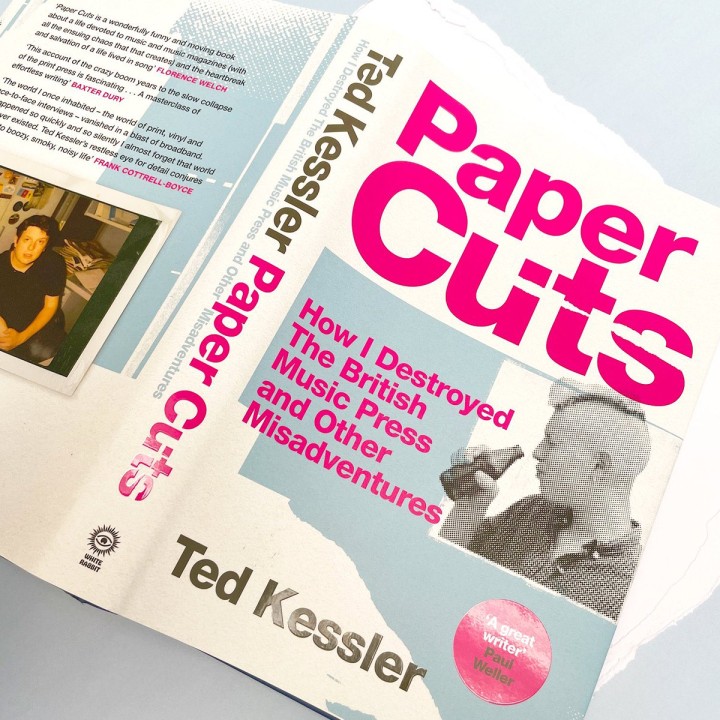
Last weekend I ripped through Ted Kessler’s brilliantly titled book Paper Cuts - How I Destroyed the British Music Press and Other Adventures. This is a longer version of the punchy review I did for the local papers.
The last ever editor of Q Magazine when the music monthly closed at the start of lockdown in 2020, Kessler shares the potent mix of his remarkable life story, interwoven with a rich commentary about the decline of the music press.
The other eye I had on this tale was my own early career choices. I often think about this world as a parallel universe down another fork on my life’s road. I started out writing about music, fashion, films and clubs but took that different path in my early twenties. Many other young journalists probably also compromised on their ambitions, but I do count myself lucky to have landed in an exciting sector. I made my home through the 1990s reporting on the television business and its technology, rather than music, stars and showbiz, later moving to Manchester to edit Insider, the best business magazine in the land. One of the reflections I used to share with journalism students at UCLAN was the access I had to real decision makers and headline makers was so much greater in the business press than I suspect it was in consumer media.
Although I’d interviewed some high-profile celebs in that phase (Ben Elton and the rapper Tone-Loc were favourites, various long-forgotten Australian pop stars, not so much), some of the PR-guided set pieces were excruciating and over-controlled. You really felt you were in their pocket and constantly on parole for good behaviour. Ironically, my best-ever scoop was about the revival of Countdown Revolution, a much-loved TV music show.
As I mentioned in this piece a couple of months ago, I have at times lamented that early choice. But deep down I probably always knew the money wasn’t good enough and the precarious nature of jobbing journalism for cool papers and mags was more than I could bear. Certainly, both Ted Kessler and Miranda Sawyer have confirmed their own financial precarity was a trade-off for an interesting life.
Journalism is a hustle. You have to constantly negotiate access to a much sought-after interview, or work out the trade-offs required to stay in the game. The business press was a different kind of dance, but there were games to play and the advertisers had more power; too much if you weren’t vigilant.
To be any good at journalism, in any field, you need courage, access and a genuine love for what you are writing about, if you don't then you are dead, because the gatekeepers have an antenna for it. Writing talent, as Ted Kessler describes, particularly for a high-output media like a weekly paper, isn’t as important. You just have to be able to knock out the copy sometimes.
I enjoyed Ted’s accounts of his own on-the-job learning, well remembering the brutal dressing-downs I had through my early career. I didn’t use words wisely, I was way too slow, and it took a while to balance the relationships that could taint a fair and accurate view of our world.
His tales of press trips and moments of genuine wonder are beautifully told, John Harris and him at an early Oasis gig, the energy of the Happy Mondays, but there was always a tension. These people weren't your friends and could snap in an instant. Maybe it’s also because the stakes were so high and the negative consequences so catastrophic. When he spends time with Radiohead and the editor ditches it as a cover story, relegating it to a chippy inside spread with poorly chosen photos, it triggers a grudge that lasts for a decade.
He gives Paul Weller’s Stanley Road album 6/10 in the NME and Weller invites him down to Surrey for a straightener in the car park of his studio.
I don’t ever remember being offered out by a grumpy TV facilities boss, but I upset plenty of people over the years. Sometimes it was my own fault. I can think of the press officers at major corporations, who were also our advertisers, who thought I was an idiot. I then decided I would go out of my way to deliberately annoy them by doing stories so offensive, so detrimental to their reputation, and so egregiously hostile, that they threatened to withdraw all advertising from my publication, and its sister titles, which were hanging by a knife edge anyway. It was high stakes but boosted my credibility and their requirement to take me seriously. And I was right, by the way, the story I worked hard to get published about them was true. And rather a troublesome idiot than a lickspittle, of which there were plenty elsewhere.
But as I matured I knew better and learned how to earn the right, to play the long game. If you’ve got a good reputation, if you do the work, serve the readers good stories, and try to be different, then your respect yields better stories. In later years, while working on a different magazine, that same advertiser flew me to Rome to interview the head of the Vatican’s TV station, and also to the World Cup in France 98. Though to prove where I stood in the pecking order it was only Bulgaria v Nigeria.
For an industry that holds its annual trade exhibitions in Las Vegas and Amsterdam, I enjoyed those years and had a good innings hanging around things I never fully understood, finding the personalities, spotting trends, and separating good new products from dross.
I was asked recently what my favourite ever story pitch was. It’s easy: “Hi Roger from Quantel here, how would you like to come to the Cannes Film Festival on our private jet?” That was a big deal. Competitors upped their game after that. Spending time with smart people brings insights, insights bring readers, readers bring credibility, and credibility gives you the freedom to be brave. Plus, though I knew Cannes was incredible from trips to the MIPCOM and MIPTV markets, the film festival was next-level insanity and glamour.
But I think the real reason I really enjoyed Ted Kessler's Paper Cuts was that it was also about the decline of publishing, the collapse of the magazine industry as we knew it, and the self-inflicted wounds that legions of halfwitted publishers administered in the name of brand strategy, diversification and efficiencies. I went through many of the same kind of corporate bollocks that Ted Kessler outlines; strategy days, meetings about meetings, overreacting to anecdotal evidence in reader surveys and off-the-cuff comments from people making an excuse not to advertise. I've lost count of the pointless memos, botched redesigns, paranoia, new managers with the latest bright idea and the sharpening of knives by young bucks on the rise. There was also a clash of priorities between advertising, editorial and corporate merger strategy.
Ted Kessler’s characters, some tragic, leap off the page. Maybe he was blessed with big names and personalities, but for his Steven Wells (RIP), we had Oscar Moore (also, RIP). Yet it remains true that no one has yet written a savage portrait of working in the business press in the way Kessler does about his world, or Laura Weisberger's novel about Vogue, The Devil Wears Prada. I just don't think my magnum opus (The Devil Wears Ciro Citterio) would be quite the rip-roaring page-turner.
The irony is not lost on me, by the way, that other hardy veterans may have well interpreted my own enthusiasm for events, video and podcasts as equally vomit-inducing careerism and therefore evidence of my own blatant hypocrisy. In a later career incarnation, I sat on the board, advocated change, and embraced the internet. As one of my American journalist friends said, "oh my God, you've become 'they'."
But you only have to look at the absolute bin fire that is the local newspaper industry to know what happens when you get the big calls wrong, promote the wrong people and fall asleep at the wheel.
But for all of that I have never stopped being a journalist, and a supporter of journalism, and loving the company of journalists, not just because of stories from back in the day, but because of all the stories they tell so well.
Paper Cuts is stuffed full of hilarious stories of wild encounters that us journalists love retelling. Trips to Cuba with Manic Street Preachers to meet Fidel Castro and dinner with Florence (but not her Machine) at the height of her success, a fair few involving Manchester music legends, Shaun Ryder, the Gallaghers and then there’s Mark E Smith of The Fall asking about the name Kessler: ‘Jew, Or Nazi?’ A story Ted Kessler’s dad bizarrely recounted with morbid glee.
But for all its depictions of a downfall of an industry, and the sad story of his Mum’s passing, the book also ends on an optimistic note. Kessler’s own Substack newsletter The New Cue fizzes with the same energy for new music and a rich heritage. It may not reach the heights of NME in the 80s, but it’s a platform for writing that matters. I hope they get the access they deserve in a world where social media gives artists the ability to totally control their brand and message, but often leaves too little a crack for the light to get in.
Scottish identity is once again surging and self-confident. Welshness is rooted in language and culture, and like the Scots, fuelled by grievance.
The Irish question seemed to have been solved by the single market for trade with Europe and a careful tolerance of individual identity embedded in the Good Friday Agreement. That looks under grave threat. A united Ireland may soon have to accommodate a belligerent unionist minority in its northeastern corner.
But should all of that happen, what of the England they would leave behind? Unlike the devolved nations it has no parliament of its own, all of the institutions of England are just the same as the British state, but with bits lopped off.
What is English music? What is English food? An English temperament, or character? But before you answer those questions, what is different from how you would describe British things?
At the height of the Euros last year one of my Mum’s neighbours displayed a massive England flag outside his house and defiantly asked her - “does it offend you?” I found that fascinating. Public displays of Englishness as a rebellion against nice people. Or a yearning for better yesterdays.
The so-called comedian Stewart Lee has a whole routine built around the outrage of a taxi driver who claims he couldn’t claim English nationality on his passport application form: “These days you get arrested and thrown in jail just for saying you’re English” (look it up).
But they are grotesque caricatures and oddities, which bring us no closer to what is different about being English, as opposed to British.
Journalist Jason Cowley has written a very thoughtful book Who Are We Now? Stories of Moden England that tries to capture who the English are through a series of encounters with people who made the news in the last two decades. Often times these are unlikely heroes or ordinary people thrown into the public spotlight in dramatic, often tragic circumstances. They include a Chinese-born man who survived the drownings in Morecambe Bay, the Rochdale pensioner who schooled Gordon Brown on the facts of life in a northern town and was dismissed as ‘some bigoted woman’, and the London bodybuilder who scraped a racist man off the pavement and saved him from a kicking at the hands of a Black Lives Matter protest.
But I kept thinking that slipping in an encounter in Wrexham or Stranraer might seamlessly add to the tapestry and say something about what it is to be British instead, but I think we’re way past that point, and no clearer about what England represents.
The closest Cowley comes to a clear definition is what he calls Southgateism - embodied by the proud and patriotic England football manager - who also pulls a diverse team together to take the knee against racism. But I think there are dangers in reducing a national identity to the roars of support for sport.
This blog is a slightly updated version of my weekly column in the Tameside Reporter and Glossop Chronicle for the end of November.
Having been locked down for the best part of two years has made us really appreciate the things we were denied for so long. There’s a real sense out there that many of you feel the same way.
Concerts, comedy nights, talks, festivals, exhibitions, films, restaurants and bars, sporting events, walks in the hills. You name it, we’ve been on it. And yet we still have massive FOMO (Fear of Missing Out) when we see other people going to things we wish we’d gone to.
Out of this darkness, some real moments of magic have appeared and I wanted to share a few of them with you. Hopefully, they’ll encourage you to get out a bit and see what might happen.
Just to give you a flavour for this, we bumped into Andy Burnham, the Mayor of Greater Manchester, last weekend. Neil had interviewed the Mayor a few weeks before for a film he made for the clothing brand Pretty Green. There was a competition to “meet the designers behind the brand” and get a discount voucher for some lucky winners. It turned out that it was actually a chance to hang out with Liam Gallagher.
Andy told us that he’d been at three gigs in a row last week - The Jesus & Mary Chain, Paul Weller, and Billy Bragg, who we featured on last week’s Music Therapy. One thing the Mayor has consistently done is support venues and give a helping hand to emerging artists across the area. One of the bands he trumpeted, Wigan’s The Lathums, supported Weller in Liverpool last Friday.
Apparently, I’ve been mispronouncing their name when I’ve introduced their tunes on Tameside Radio. This Sunday night I’ll get it right. Thanks, Mr Mayor.
Incidentally, it was brilliant to learn that the Modfather gave a support slot at his Llandudno gig last Saturday to the Tameside troubadour, Cobain Jones. What a lovely thing to do and by all accounts, Cobain absolutely rocked the North Wales audience.
We saw a similar act of generosity last Wednesday at the Plaza Theatre in Stockport. Top comic Jason Manford sold out this show two years ago, but only now has he been able to fulfil the date, even if it did clash with Stockport County’s FA Cup replay conquering of Bolton Wanderers, it was still packed. He didn’t have to, but he gave a support slot to Denton comedian Stephen Bailey, who was really good.
Neil had also seen a raucous event over in Wigan featuring Shaun Ryder from the Happy Mondays, interviewed in front of an audience of fans. The MC for the evening was Neil’s mate Brian Cannon, the graphic designer who did such iconic artwork for the album covers for Oasis and The Verve. Brian had his work cut out as his plan to steer a conversation gently was taken over by a local crowd who shouted out their own questions and Shaun answered the ones he wanted to. Pretty fitting really.
By way of contrast, we saw the writer David Hepworth at the Louder Than Words Festival in Manchester, promoting his book about British artists breaking through in America, Overpaid, Oversexed and Over There. This is a man who knows all about artists going off-script. It was David who famously interviewed Bob Geldof during Live Aid when the Boomtown Rat banged the table and urged the people at home to, er, donate a bit more money!
No such chaos at the Innside Hotel in Manchester last week, but we learnt a stream of fascinating stories. Not least that the first words that an American audience heard from The Beatles in 1964 were - Close Your Eyes and I’ll Kiss You. And boy, America certainly did.
Post script to this is we braved the wilds and drove over to Liverpool to see two delightful performances from two artists I've really got to appreciate in the last year. Jane Weaver was the support for Saint Etienne, a band I've always quite liked but never fully bought into previously. I'll have to try and think about what that might be.
Here's another resolution, I'm going to start adding the column here on this blog every Friday. Just to cross-reference it, and maybe be a bit assiduous about adding reviews of things we've done and places we've been.
It was a good job George Orwell was a set text at English A level, because I'd read everything he'd done by the time I was 16 - diaries, journalism, all his novels and most potently of all Homage to Catalonia. We studied 1984 and it provided no challenge at all.
Sometimes this doesn't leave much space to let others in. Maybe it should.
One of my guilty pleasures is Tony Parsons (the other was Lee Child, but he's basically given up now). I know it's fashionable to diss him and he does himself no favours with his opinionated column in the newspaper I refuse to buy or refer to, but I do like his new series of Max Wolfe dark detective novels. It seems that the hard-boiled crime genre I was so taken with is now the resting place of different types of novelists.
There is nothing guilty about liking Chris Brookmyre and his excellent Parlabane series, but he's definitely gone darker and more noir.
I'd say my favourites currently are Val McDermid, Joseph Knox and John Niven.
As a latecomer, I'm a little daunted at Val's output but life will always be worth looking forward to as long as there is another Val to go to; I'm up to date with John Niven though his first book, Music From Big Pink, must have passed me by and I've just borrowed it from the library. I think my favourite is No Good Deed, but nothing prepared me for the sheer unadulterated splenetic joy of the 'gateway Niven' experience of Kill Your Friends.
This weekend I binged on Joseph Knox's True Crime Story, set in Manchester, which I've written about in my column in the local paper and will link to it here when it's out. It is one of the most startling and different crime books I've read. Really smart and very well written, just like his previous three, but a real game-changer.
Next up for me is The Survivors by Jane Harper, an Australian writer who I picked up on a couple of years ago. And as soon as she's got another out, I'm on it.
Maybe it was the shrinking of our world to what was within reach that made me deeply yearn for what lay beyond. My morning walk and cycle ride saw me become fascinated with things that hadn't caught my attention - a disused piece of farm machinery became my companion and I would stop and speak to it every day, an emotional crutch and a recipient of dark thoughts. I even gave her a name - Darkness. I would also seek out abandoned barns and remote dwellings, sometimes off the beaten track, but also sometimes just tucked away, and let us remember here, they all had a Greater Manchester postcode.
I'll lay my cards on the table. Folk horror is a sometimes shocking but always dramatic film genre, never passive, never unchallenging, I can take it in small doses, but horror still works better in film than in literary fiction. The origin story starts with Michael Reeves’ Witchfinder General (1968), Piers Haggard’s Blood on Satan’s Claw (1971) and Robin Hardy’s The Wicker Man (1973) but the most shocking modern film that can trace a line back - particularly to the latter classic - is Midsommar (2019), directed by Ari Aster, also responsible for the seriously terrifying Hereditary (2018).
Here's the thing though, seeing something grotesque, otherworldly and weird is terrifying and the tricks of light and sound make it all-consuming. Reading about it is just a bit odd, but far harder to accomplish as a writer.
I say this because in fairly short order I read all three of Lancashire writer Andrew Michael Hurley's novels - the Loney, Devil's Day and Starve Acre. What I liked about all three were the dramatic descriptions of place. All three were set in locations I know a little of - the Lune Estuary, the Trough of Bowland and, less so, the Yorkshire Moors. Life feels hard for all of the characters in them, the plots are all tight, odd, and well-paced. Hurley told my friend, the writer Mark Sutcliffe, that the greatest compliment he could receive would be that if you felt you were there, in the mud, on the moors and feeling the rain, then he's done his job. I'd agree with that, and he is very, very good at atmospheric descriptive writing.
Yes, there's a but coming.
I couldn't quite buy the supernatural elements, yet in each story they are the things I remembered most vividly, and it's what gives me the shivers. I wonder out loud whether stripping them out would make them well-told thrillers, worthy of something a writer of the output and pedigree of Val McDiarmuid would do, but otherwise just bleak Northern noir.
I note that Hurley has a contribution to a horror collection out soon, and maybe, just maybe, a writer of his skill and growing confidence could win me over to the deeply weird and the terrifyingly eerie.
It got me thinking about friends who have also written books recently and have therefore been on a similar trek to the peaks and valleys of getting a book out. I'm not trying to make out I'm part of some northern renaissance movement, akin to The Frankfurt School or The Bloomsbury Set, but I am very, very proud of each and every one of them for their efforts and the end result.
I've reviewed a few of them already - so you can click through to see what I liked about the books by my University friend Shobna Gulati, our neighbour David Nolan and Manchester icon Vikas Shah.
Three of the other authors I met on Freshwalks, which says something about the network that has been created. Mark Sutcliffe joined us on a West Pennine walk just before lockdown and we became good mates quickly. Slightly by design, we would speak weekly in a scheduled group chat and I was always interested in what he had to say about anything. He's written a beautiful, handy and warm guide to walks in Lancashire, and as he inscribed in the front, 'three down, 37 to go', reminding me we've made a great start together. The epithet 'warm' is the most important here because I read a lot of walking guides that are very utilitarian. Alfred Wainwright owes his popularity to his authenticity - grumpy, shy and eccentric. I'm not saying Mark is any of these, but his love of the land, and what he encourages you to experience, is quite something.
I've also had the pleasure of walking with Natasha Jones and Martin Murphy, two very different personalities, but in their own very unique ways, really inspiring and equally fascinating. Murph's book takes you through his life story as a Special Forces soldier and applies lessons to leadership in relatively safer environments. Natasha boldly takes on the challenge of addressing toxic masculinity. It's a neat, digestible and challenging guide to tackling the root causes of poor mental health amongst men.
I've written before about the completion of my MSc thesis in political science this year. Genuinely, two of the friends who inspired me on this journey were Mike Emmerich and Jack Brown. Mike's history of modern British cities is also cited in my thesis as a key source text and he makes a well-argued case for further devolution. Jack's work on London is really challenging to a lot of the orthodoxy around inequality and the power of the capital city.
Andrew Graystone and I worked together on a short-lived political project. He's such a brave and inspiring force, and I literally can't keep up with his output. The title above is a really smart guide to social media use from a Christian perspective, but he has a new book out soon that is far more expansive.
The last physical book launch I went to was for Penny Haslam's How to Make Yourself a Little Bit Famous. I was so pleased for her, for how she successfully created this massive and impressive calling card for her business. Because of the work I do around brands and events hers is probably the closest to my sweet spot of lived experience and knowledge and I can say without fear or favour that she is spot on with her advice.
The next book launch I'm going to will be for Dave Haslam's latest, a short form essay about English revolutionaries in the sixties and seventies. I'll review it when it arrives. And then there are other friends, like me, who are at different stages with their own projects.
I'm proud of all of them. They have created something special and lasting in their own very honest and personal ways and I don't hesitate in recommending each and every one of them.