Thursday, November 07, 2013

Manchester's Graphene opportunity - an essential SmartCity goal

Manchester's Graphene opportunity - an essential SmartCity goal :

So what’s the truth about Graphene?


It will soon be a decade since two scientists discovered wonder product Graphene at the University of Manchester. For our city and for the University the work that those two eminent scientists have been doing remains vital to giving the city a critical edge.


Indeed, at our SmartCity conference on the 13th of November at MOSI we will be hearing from Mike Emmerich, the chief executive of New Economy Manchester about these developments in Graphene and how the city will benefit in the future.


But a common view expressed is that Manchester’s opportunity has gone. That this is now an opportunity likely to be exploited by America and Asia, not Northern Europe. The evidence for this lies in the number of Chinese, Korean and US patents being registered, as well as the daily production of research papers all over the word.


In an article in The Manufacturer, Dr Helen Meese, head of materials at the Institute of Mechanical Engineering, says:“The UK is at the very forefront of graphene research, but academics are increasingly concerned that little is being done to encourage industry to develop practical uses. This must change.”


She says over 7,500 graphene-based patents had been filed worldwide by the beginning of this year but only 54 were from the UK. In comparison, over 2,200 are held by China and 1,754 by South Korea. The Korean company Samsung alone hold 407 graphene-based patents.


It’s a point reiterated by a research report from the Patent Office.


But the view from Manchester is that this doom and gloom can be overplayed. The building of the Graphene Institute is evidence of a serious research facility and the appointment Nathan Hill from Oxford Instruments is a sign of series intent as is a new prize for scientific work on commercialization.


Nathan Hill’s goal is to set up a graphene Industry Club and a number of strategic partnerships with major companies and the University.


His view is: “Having lived through the development cycle of superconductor and semiconductor materials and devices, working with the great team and resources at Manchester was too good an opportunity to miss. I’m very much looking forward to supporting the next stage of making graphene a powerhouse for further research, manufacturing and jobs in Manchester”.


I’m ever the optimist, the stakes may be sky high, but hopefully there is more going on than many realise and that Manchester’s role in the future of this wonder material is bright.


via Tumblr http://michaeltaylordowntown.tumblr.com/post/66273852214

Friday, November 01, 2013

Martin McDermott RIP


Driving around two Sundays ago, my favourite radio programme played New Order's signature tune Ceremony. My thoughts immediately turned to Martin McDermott who was, as we feared, just hours away from leaving us forever after a long illness.

The next time I heard that song was today at the Crem as Martin's body was laid to rest. His music always meant a lot to him and it was a frequent pleasure to share mutual thoughts and nostalgic stories.

As a Dad you do the dutiful thing and take your kids to all kinds of parties over the years. Often the other parents on duty are the Mums. But I'll be honest and say I always particularly smiled if Martin was there at the side of a swimming baths or at a grotty play pen. It meant we could natter about New Order, the Ritz on a Monday, a bit of Man United, Michael Gove, Brian Cox, renewable energy and the things our kids say. It was always an enlightened pleasure. His mates and family told another level of story today. Their deep loss of a friend, a father, a husband, a brother, a son. It was also heartbreaking to hear of his suffering and pain, which many of them saw in such raw form as his cancer spread. But the Martin they knew also shone a light in their lives. 

Today has also been a big day for our boys who are close friends with two daughters and a son who have just lost their Dad. Friendship, comfort and kindness are what is needed now. But it's hard, really hard. We just don't know how lucky we are. 

Thursday, October 31, 2013

Malcolm Gladwell at the Liverpool Phil

To Liverpool for a performance by Malcolm Gladwell. As I've said before, I'm a fan of the pop-sociologist and storyteller. In my profile on Propermag I name him as one of my favourite "five things".

But this was a strange event. Strange, as it was in a magnificent theatre, but the acoustics were dire. I couldn't quite hear what he was saying some of the time and when it's a one-man show that's pretty important.

I was also slightly puzzled that he chose Northern Ireland for his book about underdogs, but also to speak about in Liverpool, London and Dublin. Brave if nothing else, for North Americans can get the perspective badly wrong about who the bad guys were in that conflict. I refer to this piece in the Spectator to pick up that particular point - How Malcolm Gladwell Gets Northern Ireland wrong.

But negatives out of the way - I loved how he told the story of Alva Erskine Vanderbilt, the 19th century social climber par excellence. How different elements of her story told one way portrayed her as a hero of feminism, or from another view as a tyrant and a mother from hell.

All of which was a clever way of tacking the issue of legitimacy. People pay taxes when they feel government and authority is fair and respectful - it then gains legitimacy. Taxes are avoided, in Greece for instance, when the rule of law is widely seen as unfair. And it's a lack of legitimacy which causes much of the turmoil around the world. Other political theories around detterance don't cover this.

“People choose to obey the law not because of a calculation of risks and benefits but because they think of a larger justice,” he said.

"Alva Erskine Vanderbilt was a very unlikely radical,” Gladwell said. She built monstrous houses, divorced her philandering husband and prevented her daughter from marrying someone similar, pairing her off instead to the aristocratic Churchill/Marlborough family. And it is her ferocity in the face of unfairness and a lack of legitimacy that fires her.

“She does not stand back because she does not see society’s judgment as legitimate. She has been denied on every level the basic fundamental rules of legitimacy and she is angry. She puts every ounce of her domineering and ambitious personality into the cause and she is successful.

“Alva wins in the end and the message of that victory applies as much to this day as it did then. The lesson at the end of the day is that the powerful are judged not by their ends but their means. If you deny people legitimacy then they will come back and defeat you."

All told, it was enough to make me and my pal Alex want to buy the book. We missed getting one on the night as we were being social butterflies at the bar, him with this guy, and me with another old favourite.

Wednesday, October 30, 2013

Why Russell Brand is a little bit right about globalization and politics, but why he is still wrong about pretty much everything else

image

Florid, flirtatious and fun. But also angry. Russell Brand has this week been elevated to some kind of spokesman for a generation. He guest edited the left-wing current affairs magazine the New Statesman and contributed a long essay about the importance of changing the way we think.
His entertaining interview with a glum and not very serious Jeremy Paxman (above) showed this to more people, via YouTube, than had ever even heard of the New Statesman.
It’s easy to pick holes in his comfortable pontificating from his mansion in LA, and to pick up on everything stupid thing he ever did, as this guy does here. but he has a point. And he may have hit a nerve.
I’m with Simon Kelner in the Independent when he said this: “His call for revolution may be Spartist nonsense, but Brand definitely articulates a strain of thinking among a growing number of young people who feel disenfranchised, disenchanted, disengaged and, most important, disinterested in the idea that politics can change the world.”
A session I went to at the University of Manchester this week saw four white men in suits presenting policy ideas from their respective think tanks. Yet it only really ignited when a member of the audience evoked the spirit of Rusty and asked if he was on to something or was insane. And this was in a room full of people who WANT to talk about policy and politics and all the things that are supposed to be so boring.
So what do we do? How do we engage and entertain and make relevant the things we seek to do?
The first is that we must seek out interesting people with creative solutions to difficult problems. How they talk, how they think and yes, how they look. People like Al Mackin, holder of our Tony Award, who has recently been to Tel Aviv and has a few things to say about what he found. People like Vincent Walsh who is rethinking our whole approach to food production in the city of the future.
Have I got your attention? Anyway, all this and more is on offer at our SmartCity event on the 13th of November.
You see, I don’t think we need a revolution in this country. I don’t think the system is fixed against everyone. I think there are plenty of revolutionary opportunities to make change and do things better and with more fun.

Tony Wilson on London, the North and the legacy - Chas and Dave

Listening to the Today programme this morning, I was reminded of this:

"'In the North West it rains and rains. And yet we managed to produce the best music, the Industrial Revolution, the trade union movement, the Communist Manifesto and even the goddam computer. Down South, where the Sun never sets, you took all our money and what did you produce? Chas and fucking Dave." Tony Wilson, 2007.

Monday, October 28, 2013

Marple's future in the hands of Waitrose

There's a great phrase I heard yesterday - crucibles of snobbery. That's supermarkets, by the way. The ultimate status symbol for a community is the supermarket in its centre.

I remember when it all kicked off in Marple over the college site. Dave Goddard, leader of the Stockport Council, joshed with a few of us that we were snotty Marple types who only protested because it was likely to be turned into an Asda or a Tesco. Not so, we protested. But now the possibility of a Waitrose on Chadwick Street has met with barely a flicker of protest. There's obviously the reason that the site is more suitable for a supermarket of a certain size in the centre, but there's also a frisson that a new presence will lift the whole area. I think it will. Something needs to.

Every step forward seems to be matched by a couple back. Paul Howard Menswear closing is a real loss to the Main Street. Yet it's an opportunity for Richard Morris of All Things Nice to expand his excellent deli. The result, sadly, will be to kill off one or more of the cafés on that part of Market Street, I guarantee it. 

The Waitrose option is what most people want, but it will also bring disruption, displacement and change, but it will be a sign that the media types moving in to the area are in good hands.

There's a link here - http://bbc.in/1bswIOi - to a detailed piece on the BBC magazine about the value of a supermarket of a certain character. 

The question we also need to ask is this: what if Lidl step in? And personally, I'd rather have a Booths.

Now that's better - Homeland gets good again

I'm glad I stuck with Homeland after the first slow, meandering episodes. The twist at the end of the fourth episode kind of made everything alright again. Did we ever really think Saul had turned on Carrie for the shallow political opportunistic reasons it appeared?

The double double agent mask now can create that tension and lack of resolution that made the first series so brilliant. This isn't 24 or the X-Files, this is even better than that. And there's a football story line too. And for all that, we can just about forgive this turgid sub-Hollyoaks sideshow with Dana Brodie.

Wednesday, October 23, 2013

Vikas Shah – Renaissance Man


I presented the Chairman’s Award at the 2013 Mancoolian Awards. It went to Vikas Shah, someone who I’ve got to know over the course of the last year or two.

Vikas is one of those people in business in Manchester who makes things just that little bit more interesting. Though he works in his family business Swiscot, a textiles company, what makes him interesting is the range of different things he does.

He’s been involved in setting up the Greater Manchester Film Festival, has produced a couple of films, he supports a number of different entrepreneurs – many of them with the aim to pushing the agenda of Manchester and making it a great city to do business in.

One of the first things about him that caught my eye was his blog – Thought Economics. It will never win any wards for design but for content it is quite something. Over the course of the last few years Vikas has managed to interview some of the leading thinkers and influencers on the planet., including Nobel Prize winners, business leaders and people who are changing the world through incredible work in Africa and Asia. And then there’s Sir Richard Branson. We may disagree slightly on the bearded one, but Vikas still landed a good interview.

His work with a business school in Portugal and with Manchester Business School reminds us of the need to give in order to get. He has found new opportunities through working with entrepreneurs and start-ups that need that injection of energy, ides and inspiration.

What Vikas reminded me of was the whole essence of the Renaissance Man – the multi-faceted, intellectually curious and enigmatic risk taker. Sometimes people who don’t fit the profile of the straight laced corporate man attract suspicion, rather than admiration. As entrepreneur Luke Johnson says in his book Start It Up – “Centuries ago there were no sharp divisions between state and the private sector, between science and the art. Bring back that enlightened approach!”

To me it represents something important about Manchester as well. Successful Mancunians have always had that streak of curiosity and daring about them. It was therefore an absolute delight to present Vikas with that award and to mark his move into such exalted company.


via Tumblr http://michaeltaylordowntown.tumblr.com/post/64896177119

Monday, October 21, 2013

Homeland, three episodes in and it's rubbish

How long are we going to give this new series of Homeland? I don't think I have ever felt the crushing sense of disappointment that I have with this third series. The storyline simply hasn't caught on at all. The undercurrents from Saul are just random acts of weirdness and the parallel incarceration angle in episode three is so laboured it may as well have come with a shovel. Huh.

Norman Geras - an inspiration

Norman Geras, who died last week, was a real inspiration. I never had the privilege of being taught by him at the University of Manchester - but many of my friends there did. Anyone who encountered his humanity and detailed approach to rational debate cannot have failed to have been touched by him.

My contact with him came many years later when I stumbled across his blog - Normblog. It is no exaggeration to say that a Marxist Blairite academic with a love of cricket, country and western music, philosophical discourse and political debate showed the way. He managed to provide a daily delight. When I wrote a feature about the benefits of blogging for Insider magazine he was both courteous and generous with his time. When he asked me to contribute to his weekly Friday questionnaire I was humbled.

What I took from him more than his searing intellect, or even his unique and detailed writing style, was a consistent sense of humanity and love. And from that place he was particularly critical of many on the left of politics.

He was also a devoted husband and father who obviously enjoyed a rich range of friendships. His loss will clearly be felt by all those close to him.

There's a link to an obituary, and then a link to a few more, which was often the way of the Normblog, here.

Tuesday, October 15, 2013

When a city is a character in a crime novel

Kevin Sampson on writing 'The Killing Pool' from Red Union Films on Vimeo.

To the Manchester Literature Festival to a panel discussion featuring Val McDermid, Cath Staincliffe and Tom Benn. All have featured Manchester in their work - not always by name, but the city works as a location as it is big enough to have a lot going on, but not so big that it swamps the characters.

This was all in my mind over summer when I read Kevin Sampson's first hard boiled crime book - The Killing Pool, which painted a very detailed, well researched picture of Liverpool's murky underworld. It was a good story, but it was Liverpool that seeped out from every page - warts and all. The video, above, sets out how the author set about creating such a story. I've been fascinated by this whole period ever since I read Cocky by Peter Walsh way back when. But he really brings the city to life, which was his aim.

Manchester similarly loomed large in the debut digital download novel of AK Nawaz's The Cotton Harvest. Again, another work produced from someone close to the centre of crime and the underclass in the city.

As Val McDermid said tonight, if the author does it well, then you visit a place and feel you know it. Think Ian Rankin's Edinburgh, Sarah Paretsky's Chicago and Raymond Chandler's Los Angeles.

Apologies to Helen Carter, in the chair tonight, for asking her if the portrayal of journalists in crime stories has changed and whether any of the panel were any good at it. I asked, because I think many get the workload and pressures of the journalist woefully wrong - AK Nawaz didn't, by the way. I didn't mean to put her on the spot regarding how Val McDermid does anything. A greater, more impressive force and a yet massively warm presence on a stage at a book event I have yet to see. Had I been offered an invitation to nit pick her work, I would have passed on it too. Soz.

Sunday, October 06, 2013

A proud performance at Wigan today - and Grant Hanley won't do that again


Grant Hanley Grant Hanley of Blackburn looks on during the Sky Bet Championship match between Derby County and Blackburn Rovers at Pride Park Stadium on August 04, 2013 in Derby, England,So there we were, 30 minutes in to the game at Wigan. Rovers were 1-0 up. I said to my lads - "this is the best we've seen them for years isn't it?" So in control, so positive and there's Grant Hanley, so strong and confident playing the ball out of defence. Then, bang! A Wigan player is down, the referee was better placed to see it than us. It's a red card.

I don't want to dwell on what he did, but that raised arm probably cost Rovers the game. I don't for a minute think that with 11 men on the pitch we'd have been going into injury time at 1-1. This young team is playing with purpose and style. They will be rightly gutted about leaving empty handed, but will have learned a lot about each other today. Hanley will be gutted and disappointed with himself if he's half the character he appears to be. The fact that the team were applauded off at the end - and that every one of them lined up to take that applause and gave it back to a magnificent away following - says a lot for a club that has suffered such recent trauma.

Let's wipe our mouths and start again.

Wednesday, October 02, 2013

Let's have the emotional and excitable case for HS2, please

It’s tempting to say we’d like to see a grown-up, mature and evidence-based case made for High Speed Rail, but to be honest I’d also like to see a quirky, excitable and emotional debate too.


I was at a special event with the Secretary of State for Transport, Patrick McLoughlin on Tuesday evening. There he was presented with a well argued case for HS2 from an august group of business leaders from around the North West, notably Jurgen Maier of Siemens, the current chairman of the North West Business Leadership Team. And not for McLaughlin the coded messages about blank cheques transmitted a week earlier by Ed Balls. No, the Tories are determined that HS2 will happen and that the whole country will benefit from a well delivered project.

The case for HS2 has been rather meekly made so far. I speak to many businesses and the biggest gripe is that they fail to see the relevance of a long term project that will get you to London quicker, this from Lawrence Jones of UK Fast is typical: “We don’t need to get to London quicker. It’s a waste of money when we don’t have enough to go around, and it’s not all about London, which already gets the lion’s share of all our taxes.”

Then the argument about capacity on the West Coast main line seems to get confused with how many empty seats there are in First Class during off peak periods. So when Labour’s Andy Burnham met a few of us recently he was slightly taken aback by the lack of enthusiasm for HS2 and the weakening of the supposed cross party consensus.
People also feel that budgets in their billions sound like an awful lot of money. It is a lot of money. But it is still a modestly small proportion of the rail budget if you take a long term view and measure it against all the other transport plans.
And after the dripping of negativity from Ed Balls at Labour conference, it must have been encouraging for city council leaders like Sir Richard Leese in Manchester to see beyond party politics and welcome a Conservative government supporting a project he feels passionately about, because he feels it will benefit Manchester.
Richard has acknowledged too that he’s been criticised in his own party for sharing platforms with Tory ministers: “Today I shared a platform with the Secretary of State for Transport and had no problem whatsoever. We were talking about HS2, something I passionately believe in, and something that like all long-term infrastructure programmes needs cross-party consensus to deliver. Sometimes it’s more difficult but at the end of the day they are the party of government. Every day they make decisions that impact on this city and its citizens. My job involves standing up for Manchester and that means I should take every opportunity to argue Manchester’s case with the decision makers in Whitehall.”
That’s why I want a bit of vision and passion in the debate too. I like trains. I like new technology and I get excited about dramatic advances in how we live. I like a bit of vision and bold thinking. Indeed it was heartening to hear George Osborne evoke the spirit of Isambard Kingdom Brunel, one of the greatest of British engineers.
So in making the case for HS2 it has been important to hear how it cost £10bn to improve the current main line. As prime minister David Cameron said at his conference, why settle for less than the best if improvements are needed anyway?
“The fact is this: the West Coast Mainline is almost full. We have to build a new railway and the choice is between another old style Victorian one or a high speed one. Just imagine if someone had said no, you can’t build the M1 or the Severn Bridge, imagine how that would be hobbling our economy today.
“HS2 is about bringing the north and the south together in the national endeavour. Because think how much more we could do with the pistons firing in all parts of our economy.”
But there’s the rub, if this is a North-South thing, then why not build it from here first? I also share the frustration that the consultation and then the timetable for delivering HS2 is “painfully slow”. Patrick McLoughlin revealed to us on Tuesday that the new chairman of HS2, Sir David Higgins, is keen to quicken the pace too.
As the Birmingham to Manchester dimension is in open consultation at the moment I believe it’s important to make the case for building it sooner and to start the work in Manchester, particularly linking the city centre to the Airport.
I commend the report from the North West Business Leadership Team, which can be downloaded here. The main point is that HS2 has to be part of a range of measures that tackle problems in how road, rail and air transport functions effectively. It requires a fresh way of looking at the economy of the country, it requires a shift in thinking about how we view the country, it requires, as we’ve been saying for a while, a Northern Revolution.

via Tumblr http://michaeltaylordowntown.tumblr.com/post/62927710098

Thursday, September 26, 2013

Labour isn’t the party of small business just because it says it is so


A notable grandee once defined New Labour’s relationship with the City and big business by stating that he was ‘intensely relaxed about people getting filthy rich, as long as they pay their fare share of tax’. It set the mood music for the boom years of the last decade. Both Tony Blair and Gordon Brown enjoyed a reasonably good relationship with big business up to, but probably not including, the financial crash of 2008.

But business relations have soured. Both on economic management and red tape, the Tories have secured the high ground. Not a single FTSE 250 chief executive backed Labour at the last election.

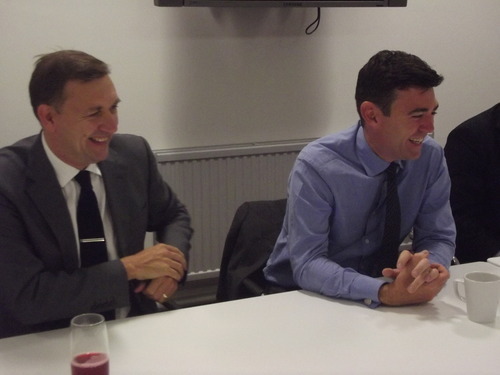
Days before Labour’s conference this week Downtown brought a couple of dozen members together for an audience with front bench heavyweight Andy Burnham MP at Manchester Science Park (pictured above, with Rowena Burns from MSP). One of the points I put towards him was the shift going on our cities and business parks and Labour’s need to engage better with businesses beyond the square mile of the City of London.

The demographic of Britain is changing. The last couple of years has seen record levels of new company formations and new businesses. According to the Start-Up Britain Tracker 382,792 new businesses have been started this year. That enormous figure may mask a multitude of different stories – it includes one-man bands, sole traders, kitchen table eBay traders, shell companies as well as a fully fledged companies with dreams of world domination.

What they all represent is that thread of aspiration through British society. A desire to get on, improve one’s lot and make money.

I wanted to know if there was room for any of that in Andy Burnham’s radical ‘aspirational socialism’ agenda which underpinned his earlier leadership bid. We have been comfortable so far with the soundings we have had with Lord Adonis as he embarks upon his Growth Review.

Too often, Labour’s left leaning rhetoric has betrayed a lack of trust and empathy with the wealth creating classes, focusing firmly on taxes, fat cats and if you close your eyes and listen to Ed Balls spit the word out – “millionaires”.

Many of the 382, 792 will not become the “millionaires” that Ed Balls thinks were undeserving of a tax cut from 50 per cent to 45 per cent once they earned £150,000 a year. But they’re not stupid either. They hear that and think – he’s going to come after me once I make a bit of money for myself. They might not pack it in, but they’ll switch off when Labour come calling.

Ed Miliband was at least right in his instincts this week when he identified an opportunity to make a Labour pitch to be the party of small business. Small companies are often the forgotten and downtrodden underdog in a supply chain, the victims of cartels and stitch ups, shut out from the closed shops of procurement processes by bureaucracy and a high bar for admission to government frameworks.

A policy to cut business rates was a step in the right direction. So too is Shadow Business Secretary Chuka Umunna’s imaginative lifting of the Small Business Saturday project from America, but there is still a great deal more work to be done to convince anyone in a business that the state is on their side, whatever the party.

Take what Chuka Umunna told the Daily Telegraph this week: “We want to celebrate companies that have good business models, which promote long-term sustainable value creation, who value their people and see business as part of society. During our time in government, we weren’t always discerning about the kinds of business models and practices we want to see.”

I’d like to know this: Where is Labour placing the tidemark on these models? No, OK, putting kids up chimneys is off, but cold calling? Lending money? Private healthcare? Entrepreneurial people tend to spot opportunities better than government. They should be supported when they do so. That support should be unconditional, otherwise the aspiration isn’t to support small business at all, just to support cool people we like, and the rest of you can just pay your tax and shut up.

via Tumblr http://michaeltaylordowntown.tumblr.com/post/62320110904

Sunday, September 22, 2013

Returning to Ewood Park - low expectations

We returned to Ewood Park yesterday for the Blackburn Rovers v Huddersfield Town game. We had great seats, were in fine company, we got well fed and the boys met the man of the match, Scott Dann, above.  We had a good day out, no question about that. It didn't ruin my night that we drew and I wasn't angry about Venky's either.

I have refused to renew our season tickets out of protest and I did stubbornly say I wouldn't set foot in Ewood Park until Venky's left. But I also wasn't enjoying it enough to justify an 80 mile round trip every fortnight. My kids have missed it though. And when the opportunity to break bread with Richard Slater came around, I couldn't resist.

There's also been a change in expectation. After the torrid last few years I simply hope for a quiet and steady period of stability. This is a young team with an inexperienced manager. The team probably lacks a killer edge, but they at least seem to have a clear sense of how they are meant to line up and play. At Doncaster the pass and move style fell to pieces, but yesterday they persisted.

Scott Dann had a good game, in fact the two centre halves bossed it at the back for the most part, save for a rare chance that forced Jake Kean to a fingertip save.

Behind the scenes the club is still facing the financial abyss. Massive losses and reduced income point towards a meltdown at some point. And it's only a matter of time before Shebby Singh pops up again to embarrass us all. But for now I'll happily settle for honesty on the pitch from a team that can only get better. 

Friday, September 20, 2013

Lessons in life from Lloyd Dorfman

Lloyd Dorfman was in town this week. He is chairman of Travelex, the people you probably change your money with when you go on holiday.

I had the honour of interviewing him at an event for The Prince's Trust. He’s a class act, a proper gent and he has an incredible grasp of detail. I wanted to get from him some inspirational stories, some anecdotes about his life, why he is such a generous supporter of the arts and of charities like The Prince's Trust and what has driven him through his life.

He started his business in the toughest of economic times. In 1976 the odds were stacked against him when he founded the company as Bureau de Change from a single shop in London and now trades more than 80 currencies in more than 50 countries.

As he built the business up, he had to fight to get into locations like Heathrow Airport. He battled the vested interests of banks and dominant players. When the opportunity came along to bid for Thomas Cook’s financial services arm, Travelex was prevented from even entering the ring. He bet the whole business on sealing that deal, but it proved transformational and projected the business to a global stage. When he eventually took cash out of the business, selling to Apax, he stayed involved, keeping a 30 per cent stake and retaining his role as chairman. Not executive chairman, not non-executive chairman, just chairman.

I didn’t pick up on this until later but so many of his stories weren’t just about the obstacles that he’d overcome, but how a relationship with a real person turned it - the official at BAA, the Thomas Cook shareholder who ushered him into the auction which led to him buying it. His relationship with his CEO Peter Jackson.

I thought to myself, even a man who operates at the very top of life thrives on such basic raw connections. It starts to emphasise something we can all too often forget: people sell people and people don’t buy from you if they don’t like you.

More than ever this is a connected economy. We are frequently reminded of this, but I firmly believe this firm human contact is more important now than it ever was. The foundation of businesses like LinkedIn warehouse your network and treat your contacts like a commodity, but you always run the risk that you miss out on what is important to any individual.

So, there you go. Spending time with one of the most successful businessmen of his generation teaches you the most important lesson in life. Don’t be horrible.

via Tumblr http://michaeltaylordowntown.tumblr.com/post/61748963182

Tuesday, September 03, 2013

Rhodes stays - glimmer of light at Blackburn Rovers?

I spoke to a mate today who said the win against Bolton was the most fun he'd had at Ewood Park since the day before Sam Allardyce joined. It was like the 80s. A team with names you can pronounce, honest players grafting out a win over local rivals and a decent atmosphere. OK, two wins don't make a table storming run. But six points is a good return. But the news that will have excited most Rovers fans is that Jordan Rhodes is staying.

I heard last week that Wigan were very confident they'd got their man. And the Daily Mail is reporting today that the player is disappointed not to be going. This is the smoke and mirrors world of football managers and agents at work. Engineering discontent.

I'm also pleased that Pedersen and Givet are moving on. They made a contribution to better times, but they need to be playing somewhere else now. I still don't demur from the view that the presence of Venky's is destructive, but it seems like we're stuck with them. I also think we're stuck in this division for a while. The team Gary Bowyer has built is suited to it. Luck can get you up, or swing against you and send you down. This at least feels stable, which has to be something.

None of the good news masks the underlying problem at Ewood. I think there's a black hole in the finances. I have long since stopped trying to apply logic to what Venky's may do next.

I have also accepted an invitation to go to the Huddersfield game at the end of the month. My Rovers supporting sons will be delighted. We've stayed away as a protest, because I want our Rovers back. The question is which Rovers we're getting back. The honest one will do.

Monday, September 02, 2013

What Bill Shankly might have said about transfer deadline day

On this day of all days, Bill Shankly's birthday, we see all of football laid bare. Transfer deadline day, where Shankly's famous quip about life and death will be crassly taken out of context. I heard a Sky reporter say yesterday we were "witnessing history" as the team bus pulled up at the Bernebau for the very last night time WITHOUT Gareth Bale.

And having just read the 720 pages of David Peace's new novel Red or Dead, there are plenty more things that Shankly said that apply to a day like today.

There's this about the players at the end of their careers, like many who won't get a deal today: "It comes to us all son. And so you have to be prepared. You have to be ready, son. Because you have to decide how you will deal with it. Will it be grace and with dignity? Or will it be with anger and with bitterness?"

And this: "I have always been ambitious. Not for me, but for the supporters. I mean, right from the start I tried to show the supporters that they are the people who matter. Not the directors. But at Carlisle, it was the same story. The same story as at Huddersfield later. The directors lacked the ambition... They were a selling club. Not a buying club."

So is the book any good? Yes, it's demanding and draws you in to its repetitive style, but the second half, charting his retirement is heartbreaking at times. It shows an incredible generosity of spirit and of selfless good deeds from a great man.

I thought Frank Cottrell Boyce nailed it with his review in the Observer.

And if you want more on David Peace, then Phil Thornton did a brilliant interview with him.

Thursday, August 22, 2013

David Peace at the Football Museum

A great evening of stimulating talk tonight. Two balding guys, a stage and some stories. The stage at the museum. The National Football Museum. In Manchester. Sorry, no, I can't keep that style up for an entire blog, but David Peace does for 700 plus pages in his new fictional biopic of Bill Shankly, Red or Dead. And when he reads it out, just as I heard an actor do last Friday on Radio 4, it is mesmerising and compelling.

But at this teaser event for the Manchester Literature Festival, Dave Haslam, a smart interviewer, does a neat trick I've seen him do before. He delves effectively and disarmingly into the subject's background, then leaves obvious questions unasked, encouraging audience participation. A very knowledgeable and inquisitive audience oblige. 

Peace was willing and open. I really enjoyed hearing him talk too. My two favourite novels are Cormac McCarthy's The Road and Alma Cogan by Gordon Burn. And in any top 10 is GB84 by Peace. He duly acknowledged the influence and style of both those books on his style and ambition. I'm also fascinated with how you weave in real living people into fictional stories. These points were duly teased out with some great answers from him.

In Peace's Red Riding trilogy he imagines dark depths of Yorkshire's underbelly. Yet what has Jimmy Saville's unmasking proved? That there was something worse? Or that abuse of power took many forms? Where else will he look for stories, for real lives to portray? Geoffrey Boycott was mentioned, and Brian Clough at Forest, possibly the greatest achievement in football. I think he sparkled most when he knocked around ideas about a Harold Wilson book, another Huddersfield/Liverpool connection, like Shankly.

I asked a question. It was something like this. "You have shown great bravery by taking risks in introducing real living people into these works of fiction. Did your experience with the negative reactions to Damned United affect how you approached Red or Dead?"

He said it did.

I hope I like Red or Dead, it is about a good man, Peace says, and a celebration of a good life in a harsh world.

Saturday, August 17, 2013

Gary Bowyer's Blackburn Rovers at Doncaster - what's it all about?

Away end at Doncaster via @theawayfans
Three league games, just one point and out of the League Cup. It's hard to take the positives out of that. Thirteen years to the day since Jack Walker died, things still look grim for Blackburn Rovers. 

My main feeling of frustration at Doncaster last night was the lack of impact from sustained passing football. That seems to be the game plan - Blackburn Rovers passing the opposition to death. But already it's looking predicatable. Jordan Rhodes just isn't getting the service as a lone striker. His body language last night suggested to me he's had enough. I'd be amazed if he doesn't go in the next two weeks, but relieved, because when the team plays to his strengths, we can beat anyone.

I quickly got the point of Paul Dickov's Doncaster Rovers - a team very much in his image - dogged, opportunistic and fit. In the second half I wasn't sure what Bowyer's Blackburn were all about. The game plan went out of the window - but all that passing and possession is pointless if players like Scott Dann and Grant Hanley can't marshall a defence to command the box at set pieces. This is a team for the Championship, it's not full of Premiership glory boys who don't like it up 'em. Though for the life of me I don't understand Josh King at all. But as a team, it should be competing at the upper end, but last night proved the importance of getting the basics right.

Does all of this mean I'm anti-Gary Bowyer? No, far from it, but he's a novice manager trying to build a team in a certain way. That's the trade off. He's never pretended to be anything else. He'll need time to prove whether he's a good manager or not. The last thing that this basket case of a club needs right now is more turmoil and upheaval.

Anyway, it was another new ground for me last night. My 137th, my 65th of the current 92 and up to 80 on the Punk 92. The Keepmoat is definitely one of the better new grounds - a complete bowl and a good location for getting in and out of. Decent atmosphere from the home fans and from the visitors in the first half. In the second half all the sourness of the last three years came out again. The intimidation, the plastic hooligans and the stunned-into-silence depressed majority. It's going to be a long season.

Friday, August 16, 2013

The three week holiday

It's been a long time since I was able to take three weeks off, but this year has been a real treat. Walking, messing about in boats, playing cricket, reading books, generally just doing the sort of casual ambling about I always have. 

But has it been a proper and total switch off? Sort of. Being self-employed means always being on call. I've had phone calls to make and emails to respond to every day. I popped down to Old Trafford for the Third Ashes Test, which was sort of work related. We went to see Rovers up at Carlisle, which felt like work. I've nearly finished a book I'm writing, but there's still more to do. Things were piling up to such an extent that on Monday this week I rented an office in Ulverston, plugged in and did a full shift catching up.

I'm not complaining, but only time will tell whether I've properly recharged the batteries. I don't think it's even possible for anyone to fully disengage. 

The one thing I do know is the experience of a view like this every morning for three weeks is remarkably good for the soul.

Sunday, August 11, 2013

The Villain - The Life of Don Whillans by Jim Perrin

Just finished Jim Perrin's exhaustive biography of the cult figure of Don Whillans, a climber and mountaineer who never really belonged. It struck me that his drinking and his bellicose aggression fit that mould of working class men who invite the tag - 'could have been greater' but achieve cult status anyway. You think of Gazza, George Best, Liam Gallagher. A generous view will have it that they fought incredible odds to achieve amazing things in the face of establishment hostility - or they use their upbringing as an alibi for failure.

Whillans came from Salford and was a brawler and a rough neck, yet he found an expression in rock climbing. His love of exploration starting when his parents took him to stroll around Roman Lakes in Marple (so there's hope for my lot yet). In his life, which Perrin has been meticulous in researching, he climbs all over the world and with climbers who became household names - like Chris Bonington and Doug Scott. He becomes a popular lecturer and even appears on This is Your Life and other TV programmes.

My own personal interest in his story comes from my Mum's dear friends Ian and Nikki Clough, both no longer with us. Ian had died on Annapurna in 1970, an expedition that Whillans was on, and was described as epoch-making. Nikki had cancer and passed in 1983, which hit my Mum hard at the time, and it seems, Whillans too.

I love books that get under the skin of a culture and Perrin does this in great detail and with searing honesty. There was obviously a terrific bond amongst climbers, a counter culture and an establishment that weave between each other. There's also the prolific shoplifting, scrounging, grafting and hitch-hiking, behind this frontier banditry though are fierce rivalries and sniping that makes the comedy circuit look like a band of brothers.

The lengthy footnotes in the book make it a tricky read. It would have been better to weave some of them into the narrative as anecdotes and asides. But for all that it was a compelling book. It isn't a eulogy to a friend, or a hatchet job, but a careful and thoughtful portrait of a flawed genius with demons and very obvious failings. To his enormous credit, Perrin looks at many anecdotes and myths from all angles, he was earmarked for an MBE but it coincided with him fighting with police when he was knicked for drink driving. If I'm honest, I find Whillans to be a very unlikable character who hurt too many people. But they are judgements Perrin invites you to make, rather than forcing his view on you.

Could he have been a contender? Well, he was. For all of his status as "Whillans the Villain - the outsider" he had a great deal more recognition and respect than he probably wanted. The mark of a true outsider is that they place themselves there by choice.

Thursday, July 25, 2013

Summer reading tips - a few books to get through

I love the summer holidays for catching up on topical reading, it’s a good time to open your mind to fresh ideas, escape with a story or just learn something new about our wonderful world. Apart from Lake Coniston, here’s what I’ll be diving into.

‘The Cotton Harvest’ by AK Nawaz I love urban crime noir. My favourite of this genre is James Crumley who set his grimy tales in Missoula, Montana. Having never been there I can’t properly say whether he’s done a good portrayal or not. Anyway, I know who AK Nawaz is (this isn’t his real name) but he should be able to get a decent grip on Manchester crime.

‘The Killing Pool’ by Kevin Sampson, set in Liverpool, Sampson has a good ear and a ready feel for all walks of life. His Awaydays was superb and this looks the business as well.

'The Atmospheric Railway and other stories' by Shena Mackay - I first read a collection by this quite brilliant English writer when I backpacked around Turkey in 1986. I'm looking forward to this collection after picking it up at a church sale last month. 

Welcome to Entrepreneur Country by Julie Meyer So far this has been an easy to read, but hard to swallow business book for a holiday. I like the crazy utopianism of Julie’s world view, which she advanced so elegantly at a Downtown and TechHub event earlier this month.

The Last Days of Detroit by Mark Binelli – Anyone involved in city politics and urban development looks at Detroit with horror. In fact, everyone looks at Detroit with horror, except the tourists who come to photograph urban decay and say they’ve come to see what the end of the world will look like. The former Motor City has recently gone bankrupt. Now I’ve had this for a while and have been dipping into it, but it’s a well argued, well researched examination of what went wrong and how it can bounce back.

‘The Quarry’ by Iain Banks – the last book by the recently departed Scottish author. I have really enjoyed The Crow Road and The Business and love the premise of this one, a group of university friends gathering together years later. Also touches on themes like parental mortality and autism, personal interests of mine.

‘Northern Monkeys’ by William Routledge – OK, I have a vested interest in this compelling anthology of quality musings on fashion, football and frolics through the years, but it’s still a great book to discover new insights and nuances. A wonderful reference and a work of beauty.

Five Days in May by Andrew Adonis - Having spent a bit of time with Andrew Adonis this year I have been impressed at his determination to get economic policy right for Labour, but also to work across party lines to articulate projects in the national interest – like HS2, Academies, promotion of LEPs and apprenticeships. This is his insider’s account of the birth of the Coalition government.

That should get me through the first week, any other suggestions gratefully received.


via Tumblr http://michaeltaylordowntown.tumblr.com/post/56432452426

Friday, July 19, 2013

Rose Hill Stores, a sad and predictable end

It would be a heart of stone that didn't at least feel a modicum of sympathy for the owner of Rose Hill Stores, which closed for business last week. Shortly after buying the old Post Office site and opening a Spar convenience store, the neighbouring shop, Thresher, went bust. He didn't cause their demise, far from it, but it did show that Soviet style planning and licensing of shop types doesn't exist in this area. There's a link here to other blogs on the store wars.
He also started selling newspapers, something plenty of other shops in Marple do, and are having to find other things to add to their offer.
Not long after, the next door shop was turned into a rival and bigger convenience shop, owned by a chain with bigger buying power, the Rajah Brothers.
Then it got ugly. Undercutting, police raids, accusations of intimidation and rows over access to the car parking at the front. The pictures above illustrate the lengths the owner went to in order to prevent cars parking on the land by his shop in order to shop at the Premier. Bollards and chains also made it very hard to park there, and threats not to shop at Premier if you parked there. I only ever went to Premier once, when Spar didn't have what I needed. I gave up when the parking situation got unpleasant. 
The only possible lesson you can take from it is that whenever you start any business there will be competition. You too will be someone else's competition. Not one single customer owes you their loyalty because you want to be in business, or because you are a person like them, just trying to make a living. Time and again independent shops are up against multiples. It is hard, very hard. But the ones that succeed aren't the ones that worry about what the competition do, but who think about what the customers can get that the competition can't do. 

In happier Marple retail news, I notice that Felix at Murillos Tapas Bar and Restaurant has opened a deli counter. Good luck mate.

Confessions of a Groundhopper - blogging for the Northwest Football Awards


One of the first things I do when the fixtures come out is look out for all the away trips that can take in a new ground.
I admit it, I’m a groundhopper and this is my confession. I’ve watched football on 135 different grounds around the world, all but a dozen in Britain. I love the feeling of walking through the turnstiles at a new ground, sampling the atmosphere, tasting the pies, weighing up the balance of two teams of toilers at an unfamiliar standard and feeding off the crowd's knowledge of who is who.
One of my favourite ever football books is The Football Grounds of England and Wales by Simon Inglis. He lovingly describes the architecture and the setting of each ground.
I also devoured the photography of Stuart Clarke – Homes of Football.
Last season I notched off Chesterfield as the 76th of the current 92, partly as a homage to see Adebayo Akinfenwa, the cult Northampton Town player and a favourite on FIFA 12 on the Xbox.
Except it isn't, it was my 63rd. I've lost 11 who have new stadiums, and then there is the Wimbledon situation which I'm not sure how I count that.
On the Punk 92 I'm at 76. That is, if you’ve watched one of the 92 at their ground it counts.

Of the92.net rules, it's 63. Same with the 92 Club.
I have a badge celebrating my membership of the 100 Grounds Club, and love visiting the blog with its stories of toilet blocks, railway sleeper terraces and rebuilt clubhouses.

But as I said, I count non-league as well and of the total grounds visited it's now at 135. My short term targets are to get all the Greater Manchester non-league grounds.
In an age when so many new stadiums are so boring and so much the same – it’s a treat to sample a rough character of the non-league set-ups. It’s great that the North West Football Awards has such strong connections to the grass roots of football through community clubs categories and a recognition of the progress made throughout the Conference and Conference North.
To give my non-league adventures a bit of a purpose I'm going to try and chalk off the Greater Manchester grounds this season.  But next up will be Glossop North End this Saturday, then any one from Curzon Ashton, Radcliffe Borough, Ramsbottom United (steam trains too!) or Trafford.
Also as a part-time Blackburn Rovers fan I’ll be taking in away games, especially targeting new grounds - we’re looking forward to Doncaster Rovers in the league this season for a first trip to the Keepmoat Stadium on August the 16th.

Friday, July 12, 2013

Somewhere beginning with M - Manchester - Melbourne connections


Melbourne Australia: World’s most liveable city (by InvestVictoria)
via Tumblr http://michaeltaylordowntown.tumblr.com/post/55248428374

Something beginning with M - the Manchester Melbourne connection
I only lived in Melbourne, Australia, very briefly, but it’s a city I admire greatly. And it’s a city that Manchester has much to learn from and both cities have much knowledge to share.
There’s a love or sport, music and clubbing. Both are cities with proud traditions of welcoming immigrants – Melbourne has the second largest Greek population after Athens and yet still has more Italians than Greeks. All of this has been flooding back recently as I’ve finally got round to reading The Slap by Christos Tsiolkas, I know, the book everyone had their head in two years ago. But it’s set in Melbourne, and has provided something of a tour of this ethnic, cultural and sometimes tense melting pot.
Mancunians also share a certain chippines about the main city in our country. Sydneysiders have a swagger and an arrogance and think their city is the first and last place of importance in the country. Sound familiar?
So I was delighted to read in Monocle magazine that Melbourne was named the second most livable city on the planet this year, tucked in behind Copenhagen.
The factors that fell in Melbourne’s favour included a strong economic performance – noting positive jobs growth, regional infrastructure developments, but also improvements in cycling and public transport.
I like the Monocle annual quality of life index because it picks up things that other surveys ignore, but are integral to the happiness of creative and urbane people who value things like shopping hours and amount of outdoor public seating.
As the capital city of the state of Victoria, Melbourne has the feel of a confident and progressive city. It is more industrial and mercantile too, innovative and attractive to international companies. KPMG research found it to be the best city in the world to carry out commercial scientific research, thanks to a generous tax regime.
The state government will give back 45 cents in every dollar spent by start-up businesses with turnover under A$20m, but it’s not just the system, but the ease with which it is implemented. How often do you hear the complaint that UK tax rules are so complicated businesses just don’t bother applying?
But I also return to the issue of autonomy. By targeting research and development, and making some adjustments to its tax policy, the state has been able to make this commitment. We indeed have much to learn and share.
I say all of this, because I’m meeting with a cross-party group of MPs from the Victorian State Parliament next week. They are coming to Manchester to find out about how this city has achieved so much. The public private partnerships here are admired around the world. So it’s particularly flattering that a city like Melbourne has much to learn from Manchester. But I shall very much enjoy the interchange of insights and look forward to sharing them with Downtown members too.
I am currently holding my breath as to whether cricket will be a topic for discussion.

Thursday, July 04, 2013

We have to get a move on – or HS2 will bring our talent closer to London


Imagine a scenario when High Speed Rail gets built. That the cities of the North have still lagged behind. That Scotland has a generous corporation tax regime that draws in ambitious technology businesses to Glasgow and to Silicon Glen. And that London continues its inexorable rise as a global powerhouse.

A new train line that can take people from Manchester to the centre of London, to a newly built Euston station (pictured), in just over an hour, does just that. It draws people in. Just that. There is no reason for the traffic to be two ways – few other meaningful businesses have followed the BBC to MediaCity and the public sector is still the biggest employer in large swathes of the North.

It simply can’t happen. It simply can’t be allowed to happen. And if we needed any further impetus to get political leaders in the cities to dig in for greater autonomy and power to have serious control over government budgets in an effective way for our urban economies, then this is it.

Geoff Muirhead, the former CEO of Manchester Airports Group made these points and more at our Northern Revolution conference yesterday.

This is the one that sharpens our senses though. If you accept the arguments that HS2 is going to happen, then we recognise it presents a challenge to the North as much as it does an opportunity. The prize is double edged – just relying on it and becoming a far flung suburb of London would be a disaster. It has to be more than that.

Any successful city has to create its own magnetism – a reason to draw people in, retain the talented and mobile, and provide a living and a quality of life for its people. And that’s the challenge of all of us.

Mike Emmerich, chief executive of new economy, an articulate and wise servant of the city who has experience of working in Whitehall, made the good point that public and economic policy needs to work on what is organically there. Otherwise it will fail. There is plenty of evidence of that all around us of abandoned schemes to dream a shiny new building into a rundown town and hope the investment will follow. It’s harder than that. It’s about economic performance, people then place. In that order.

via Tumblr http://michaeltaylordowntown.tumblr.com/post/54619994836

Wednesday, June 26, 2013

School's out - the idiocy of the teachers' strike

Tomorrow schools in the North West will be closed because of a strike by teaching unions. Without even breaching the reasons behind this, the whole fiasco is totally avoidable. The very threat of a strike, irrespective of whether individual teachers choose to withdraw their labour for the day, means schools will have to close. Schools can't ask who is going to strike and who isn't. Schools can't open with a provisional staff. And yet the very risk that kids will be left unsupervised will mean parents have to take a day off work and kids will miss lessons.

The barmy thing is that all the teachers could turn up to work and still get paid, but have no lessons to teach. But the school won't know in time to make the decision on whether to close or not. As I said, stupid.

As for the reasons why they're striking, I don't agree with that either. That's my personal view, of course, not that of the governing body I sit on. Reform has to come in teaching. Reform has to come to public sector pensions.

Tuesday, June 18, 2013

MOSI - a cautious welcome

Downtown Manchester in Business offers a cautious welcome to the announcement today from Ed Vaizey, the culture minister, over the future of MOSI.


However, the very fact that the future of this fine Manchester asset has been called into question is unacceptable.


Businesses in the city have been galvanised into action to protect MOSI, but also wish to partner with the board and trustees to ensure that the financial future of MOSI is guaranteed for future generations.


I hope that a new spirit of partnership can grow from this period of confusion and turbulence.


via Tumblr http://michaeltaylordowntown.tumblr.com/post/53272070561

Friday, June 14, 2013

Scotland the braver – the North of England’s noisy neighbour

I was up in Glasgow this week for Scotland’s Technology Show. It was an exhibition of a wide range of technology companies and featured a large presence from Scottish Enterprise, of which there is no equivalent in England, or in our Northern cities. And on the back of BBC’s Question Time from Edinburgh last night, I came away with 5 thoughts that have shifted my view of our Caledonian cousins.

Maybe it’s because I’m a political anorak, but I kept musing about what difference an independent Scotland would make to this event in the future, and to the business owners I met up there. I’ll be honest with you, I just don’t get Scottish nationalism. I thought any ambitions of a new independent nation joining the “arc of prosperity” from Norway to Iceland and Ireland would have been buried in the rubble of the financial crisis of 2008. The rhetoric of the SNP is also of a bygone era of high state spending with no real understanding of the kind of dynamic economy an independent Scotland will need to be. Plus, most of the oil is in English waters if you draw the line correctly.

Yet there is still a momentum behind this most implausible of political projects, one that will grow stronger as the gap between London and the other regional cities grows larger. I am pretty sure that full independence will be bad for Scotland, even though I’m not really entitled or required to have a view on that. But I’m still not sure as to whether it will be good for the North of England, or not.

What I am sure of, however, is that the institutions that Scotland has are making a better job than I previously thought of creating the kind of economy that it needs, whether a devolved part of the UK, or a small independent member of the European Union.

As we prepare for the Northern Revolution conference in Salford Quays, on the 4th of July it’s as well to learn from other places where policy and planning are working.

Here are five things I learned this week that show Scotland is heading in the right direction. And maybe Northern cities, or a collaboration between them, could study a bit closer.

1. The Scottish Investment Bank (SIB) – I like how the umbrella body of SIB operates a suite of investment funds. It provides clarity, a relatively lean and no nonsense model and does co-investment with a well established network of business angels through both the three equity funds and is also the lead investor in the privately managed Scottish Loan Fund.

2. Scotland’s Technology Show – the spirit of co-operation and excitement amongst disparate companies in Scotland to show off their products at a domestic trade show was impressive. It wasn’t to meet buyers of subsea marine engineering products, but it was to share ideas and meet other technology companies with similar ambitions.

3. There are more entrepreneurs in Scotland than ever – this was a trend that surprised me, but beyond the headlines, start-up rates are still way behind the rest of the UK. According to the Global Entrepreneurship Monitor, Scotland is retaining start-ups and has a high proportion of people of working age who have started a business. Sir Tom Hunter, who endowed the Hunter Centre for Entrepreneurship at Strathclyde University, thinks there is a reason for this: “Ultimately it seems we need to continue the cultural shift towards enabling our people to recognise entrepreneurialism as a real career option. We are in the teeth of a recession but when I started out in a similar recession there was very little by way of support. Today it’s different and I really do believe that we are finally integrating the support network for aspiring entrepreneurs.”

4. Entrepreneurial Spark – I led a panel debate with Jim Duffy, the CEO of this incubator and accelerator, and he had a great story to tell. His free Start Up Accelerator takes businesses through a tough 5 month process to get them in good shape.

5. Royal Bank of Scotland edging towards privatisation. Stephen Hester has done a good job getting RBS ready for a return to private ownership, even though he won’t get any thanks for it. But the reach of the bank into Scotland’s business base means it desperately needs clarity of its future if it is to be effective. It either shrinks and withers, or it is managed to a sustainable size. Never again can it be allowed to be sprawling empire Fred Goodwin spawned.

From a lower base, and with a much weaker entrepreneurial culture the picture in Scotland is looking brighter. It’s as well to keep an eye on this noisy neighbour, whether we need our passports to do business with them or not.


via Tumblr http://michaeltaylordowntown.tumblr.com/post/52940755153

Friday, June 07, 2013

Why Downtown says: "Save MOSI"


There’s a danger that once any regional business ties its fortunes to a London centre – its chances of survival diminish. That’s why a campaign to save Manchester’s Museum of Science and Industry (MOSI) has so taken root in the city and has fuelled a strong sense of injustice.


MOSI isn’t just a ‘nice to have’ attraction in the city centre, it’s an integral part of what Manchester is all about. The start of the world’s first passenger railway service and a valuable educational resource for our children.


Downtown Manchester in Business has had no hesitation in taking a leading role in the “Save MOSI” campaign and have already begun the process of lobbying and voicing our view on this issue. I was on BBC Radio Manchester with Graham Stringer MP drawing a line in the sand on this issue and we have sat down with a number of other businesses in the city to kick off a campaign and agree its scope.


We must from the outset applaud Yakub Qureshi from the Manchester Evening News in bringing this story to the public’s attention and for Downtown members in expressing their outrage on social media sites.


The threat to MOSI comes as the national Science Museum Group is considering shutting it and the National Media Museum in Bradford and the National Rail Museum in York.


The Manchester Evening News reported: “The three northern visitor attractions, which are all part of the London-based museum group, have been put on the chopping block because of funding cuts.”


The last thing any of us in Manchester want to do is engage in a tawdry competition with Bradford and York about who deserves to survive more. Frankly it should never have got to this. It may suit the trustees of MOSI and the Science Museums Group for everyone to target the collation government and the ‘cuts to the arts” agenda. But that’s not the point either. What is the issue here is how important institutions are run and how they are supported and for who.


This campaign is only at the beginning, but it will also throw to the fore some important questions about MOSI and what it is for and how it can be improved too. That’s why we call on businesses and members of the public to start from the premise that MOSI is vital to future scientists and engineers and for the curiosity of Manchester and its visitors.


We also need to remind The Science Museum Group that they have a commitment to transfer all existing Grant in Aid on the condition that the site and collections would be preserved for a minimum of 25 years.


While we appreciate the trustees have a difficult job to balance their budget in the teeth of cuts to their budget, it is not acceptable that MOSI can be sacrificed, or that it can be even considered for closure.


As Graham Stringer MP told the Manchester Evening News: “I’m appalled at the idea we will end up with only museums in London. Something like 90 per cent of the funding for art galleries and museums goes into London already. It’s an extraordinary amount.”


Andrew Stokes, chief executive of Marketing Manchester, says: “MOSI is a museum of national significance and its visitor figures speak for themselves. Its location on the site of the world’s first passenger railway station adds to its appeal and provides a real tourism hub for the Castlefield area. Marketing Manchester will support wholeheartedly any campaign to keep the museum’s doors open – not only for the people of Greater Manchester, but also for the million international visitors a year that the city attracts.”


Jonathan Schofield, tour guide, and Manchester Confidential editor, says: “What is certain is that proposing something as blatantly unfair and desperate as closing all the Science Museum Group’s northern properties while keeping on the equally struggling London one looks shocking.”


So, stay posted, stay close and above all, Save MOSI.


via Tumblr http://michaeltaylordowntown.tumblr.com/post/52362593749

Saturday, June 01, 2013

A few more thoughts on how to enjoy the Hay Festival

https://www.hayfestival.com/wales/img/press-photos/highres/2013/18.jpg
Kids at Hay, joining in. Pic by Finn Beales


A good pal of mine described Hay as where the earnest reek of self improvement collides with the overwhelming stench of smugness. Of course he's right. Entirely. But, I like it for no other reason than it can throw up the possibility of enjoying someone sharing an idea you had never, ever thought of before. What's so bad about that?

Here are some thoughts I had from this time.

Go to a live recording of a radio programme. It's good fun, professionally run and as it has a multitude of guests from all around the festival. On Suzie Klein's Radio 3 Drivetime programme we had Peter Florence, the founder of Hay; maths guru Marcus du Sautoy, psychologist Oliver James, historian and writer of a new book on 1913 Charles Emmerson and my favourite of them all, Amit Chaudhuri who was talking about his new tome on Calcutta. We also saw the brilliant Ian Macmillan with band called Wora, writers Rupert Thomson and Tiffany Murray and a Welsh language poet Menna Elfyn.

Get kids to do stuff. Doesn't matter what, but it helps them get something out of a poet, writer or an illustrator if they can join in. We saw Dan Abnett, a writer of comic books do a whole session on how to draw a dragon.

Talk to people. OK, so my kids thought the risk of talking to a Tarquin was too much of a stretch out of their comfort zones, but it's always really nice to chat to people in queues and at the shop about their experience. And I have yet to regret stopping to chat to an author you recognise. They are always pleased to do so.

Some events are seemingly unrelated to books, ideas or anything at all, but they work. Take Michael Vaughan on the Ashes. He said more about team work and workplace psychology than any amount of experts.

Travelling through Wales, or England? We drove there via Wrexham and then through mid-Wales. It was beautiful, but exhausting. The drive home via Leominster and Shopshire and Cheshire was quicker and easier. We did the train in a day last year and it was harder work than it should have been.

Asda and the College scrap their plans - so what now?


It was announced this week that Asda and Cheadle and Marple College have scrapped their plans to build a supermarket on Hibbert Lane. I welcome this news as it was a bad scheme, badly thought through, poorly located and the wrong solution to local challenges.

However, it throws into the mix the possibilities of what should happen now. I liked the conciliatory line in the statement about consulting with the community about the best use for the site, but ultimately it is a matter for the governors of the college to fulfill their duties to provide education in a sustainable way and be responsible for their estates, here's the statement:
"Following the refusal of planning permission at the planning and highways committee, both the College and Asda have been carefully considering their position and contractual obligations.  Both parties have been in discussions with each other and their respective Boards about their appetite to proceed and the prospect of an appeal.  Both parties have indicated a preference to withdraw from the contract by mutual consent and have instructed solicitors to draft  an agreement in this respect.

"The College has been considering a number of options of how to proceed and would very much like to work with the Marple Community to explore a way forward.  It is our intent to collaborate and consult with key stakeholders in this respect." 
So here are a few new challenges for the community leader who articulated so powerfully what needs to be done next.

The College. There is no doubt that the College needs to do something new, and it needs to get a move on. Other colleges and schools are so much better equipped. Resources are tight, but the need to have a new campus, possibly on Buxton Lane will have to be costed within what is possible from developing Hibbert Lane for housing.

Chadwick Street Site. This development will also encourage Kirkland to proceed with plans for a town centre store. I've pondered before whether Marple is an Aldi or a Waitrose kind of place. I'm pretty certain the store was designed with Waitrose in mind, it is now a commercial decision as to whether they want to proceed.

Traffic. Something needs to be done about the roads round here. They just don't function properly. The traffic management is all wrong. I like what's been done in Poynton, but there are too many complicated one way routes at the moment and unflowing movements for it to flow round here.

Independent retailers. Free markets throw up the possibility of risk that a business won't work. I don't necessarily just shop at local independents just because they are independent. I welcome well run branded multiple retailers: I go to Greenhalgh's because I like their Broccoli soup, I get repairs done at Zipyard because they are friendly and cheap. This is not the devil at work. Everywhere has empty shops too, good ideas will come to the fore. But it's important that a college is supported in Marple, or many of these butty bars and pie shops will go out of business. 

Sports facilities. The football pitches and sports grounds round here are woeful. Marple Hall School astroturf is a misnomer, it's concrete with a thinning carpet. The swimming pool and gym are pretty ropey too. So, in working out what next for different land sites, surely this should be factored in. The set  in Woodley is good, but it's 4 miles away, and it's expensive. It should be factored in. And I don't accept that putting up full size posts on an unplayable pitch on Hawk Green is a meaningful contribution to local sports.

The media. How rubbish is it that the local weekly paper is so stuck in the cycle of weekly news there is no news outlet for news of this importance for Stockport and for Marple? Even the press statement seems to have been sent to the local messageboard.

I don't like saying NO to progress, so I look forward to the day when I can have a YES poster in my window for something positive and bold in Marple.